

June Drywood Termite Swarms in Chatsworth, CA
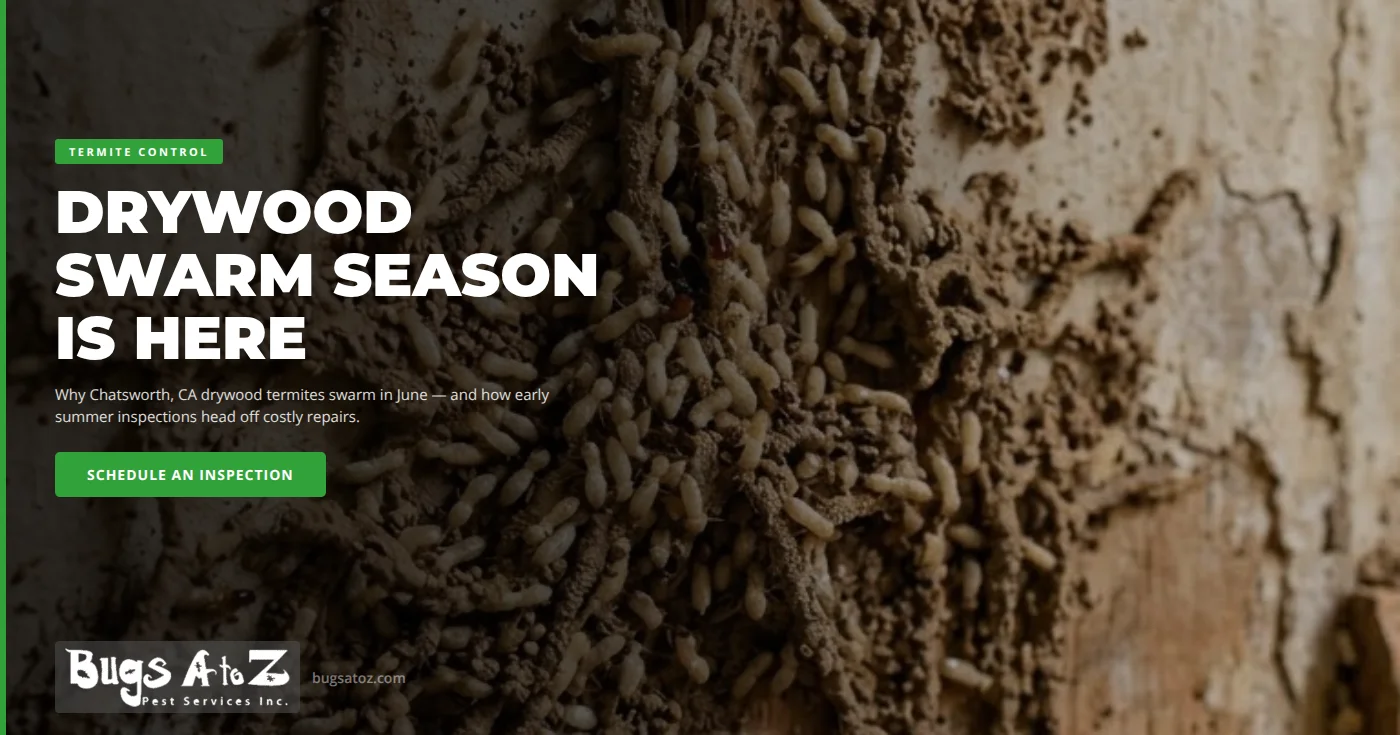
June Drywood Termite Swarms in Chatsworth, CA
The first 90-degree weekend in Chatsworth always brings a familiar call. A homeowner finds a small pile of cellophane wings on a back-bedroom windowsill, or notices what looks like coffee grounds collecting under a garage beam. By early June, the calls about drywood termite activity start stacking up across the western San Fernando Valley.
We are Bugs A to Z, and Chatsworth, Porter Ranch, Granada Hills, and Northridge sit in the heart of our service area. The western Valley runs noticeably warmer than coastal Los Angeles, which means our drywood swarm window opens earlier than it does down the hill. This guide walks through what June brings, how to tell a termite swarmer from a flying ant, where swarms get in, the signs of an active colony, why older Chatsworth construction is exposed, what an inspection covers, the difference between drywood and subterranean treatment, and how to protect your property year-round. The closing section explains how we approach termite control in Chatsworth.
Why June Is Peak Drywood Termite Swarm Season in Chatsworth
Western drywood termites (Incisitermes minor) are California's second most economically damaging termite species after subterraneans, and the San Fernando Valley sits squarely in their range. According to UC IPM's western drywood termite guidelines, coastal Southern California typically sees its heaviest drywood swarms from late September through November. In hotter inland and desert pockets, swarming begins much earlier — and Chatsworth's western-Valley microclimate puts it on that earlier curve.
By early June, daytime highs in Chatsworth routinely climb into the upper 80s and low 90s while overnight lows stay above 60. Sustained heat plus the first long dry stretch after spring rain triggers the season's first drywood reproductive flights. The colonies inside a beam or rafter are not new — most have been active three to five years before they produce swarmers — but June is often the first month a homeowner actually sees winged termites pile up against a window screen. Add the wrap-up of subterranean swarms (which peak in spring rains across Los Angeles), and early June is the single best inspection window of the year to catch both species before summer hides the evidence.
How to Identify a Drywood Termite Swarm vs. Flying Ants
Most Chatsworth homeowners who call us after a swarm have already spent ten minutes online trying to decide whether the bugs on the windowsill are termites or carpenter ants. The body design is different enough to settle with a hand lens.
- Wings. Termite alates have four wings of equal length, longer than the body, with a dark vein along the leading edge. Flying ants have two long forewings and two shorter hindwings.
- Waist. Termites have a thick, straight waist. Ants have a pinched, wasp-like waist.
- Antennae. Termite antennae are straight and beaded. Ant antennae bend at a clear elbow.
- Color. Western drywood swarmers are dark brown to reddish-brown with smoky wings. Carpenter ant swarmers in our area are solid black or black-and-red.
- Wing piles. Drywood termites shed their wings within hours of landing, so the diagnostic finding is often the pile of identical glassy wings against a sliding door track, window sill, or light fixture.
Equal-length wings, straight waist, beaded antennae — that is a termite swarm. Bag a few wings and keep them; species ID is the first question we will ask on the call.
Where Swarms Enter San Fernando Valley Homes
Drywood termites do not need soil contact, which is what makes them so different from subterraneans. A reproductive pair only needs a small crack in dry, sound wood somewhere above ground. In Chatsworth, the predictable entry points repeat on almost every job.
- Eaves and fascia. South- and west-facing eaves are the hottest wood on the house. Cracked paint, weathered fascia ends, and exposed rafter tails are the most common drywood entry points in the Valley.
- Window and door frames. Older wood-frame windows exposed to afternoon sun develop hairline checks where a pair can wedge in. Garage door jambs are a frequent finding.
- Attic and gable vents. Damaged or missing 1/16-inch screening lets swarmers fly directly onto rafters, ridge boards, and tongue-and-groove sheathing.
- Patio covers, pergolas, and exposed beams. Decorative beams that pass from outside to inside — common on mid-century Chatsworth and Porter Ranch homes — bridge outdoor weathered wood into the framing.
- Fences and detached structures. Workshops, sheds, and old wood fences often hold the colony that produces the swarm. The fence colony does not threaten the house, but it sources the swarmers that drift into the eaves.
The single most common pattern we see is a colony seeded in a patio cover that sends a second generation of swarmers into the eave detail three to five years later.
Warning Signs of an Active Termite Colony
Drywood termites live their entire lives inside the wood they eat, so the colony is almost never visible. What you will see is the byproduct of the colony's daily activity. These are the signs we walk every Chatsworth inspection for.
- Frass pellets. Drywood frass is the single most diagnostic finding in the industry. Pellets are roughly 1 millimeter, hard, dry, and hexagonal with six concave sides under magnification. Color ranges from light tan to dark brown depending on the wood. Pellets accumulate in small piles below the colony.
- Kick-out holes. Drywood termites chew small openings — under 2 millimeters across — through which they push frass out of the wood. The holes are often plugged with a dark spot of compacted pellets the homeowner mistakes for a knot.
- Discarded wings. Piles of identical glassy wings around windows, sliding doors, and light fixtures after a swarm.
- Hollow-sounding wood. Tap a suspect beam with the handle of a screwdriver. Drywood-galleried wood sounds papery and hollow next to the dull thud of sound lumber.
- Blistering paint. When a gallery runs close to the painted surface, the wood loses integrity and the paint develops blisters or sunken patches that do not match the rest of the trim.
Pellet piles below a suspect beam and discarded wings inside the structure are the two findings that most often change a treatment plan. Either one means the colony is actively producing, and the inspection needs to extend into the attic and crawl spaces.
Why Older Chatsworth Homes Are Especially at Risk
Chatsworth's housing stock is heavy on post-war ranches, mid-century split-levels, and 1970s-1980s tract construction with the kind of architectural detail drywood termites love. Exposed-rafter eaves, decorative beams that pass through the wall plane, and wood-sided dormers were standard on Valley ranches built between the 1950s and 1970s. Decades later, the paint film on those details has weathered, the wood has dried and checked, and the cracks are wide enough for a swarming pair to colonize. Original wood-frame windows and wood garage doors compound the exposure on southern and western faces.
Attic construction matters as well. Many older Chatsworth homes have generous attic volume, board sheathing rather than plywood, and venting that has lost its screening over the decades. A drywood swarm that hits a gable vent on a hot June afternoon can settle directly onto the ridge board or the back of the fascia and run undetected for years. The hillside lots up against the Santa Susana foothills also see more wind-driven swarm traffic from the native chaparral, where natural drywood populations live in dead oak and walnut limbs.
What a Professional Termite Inspection Includes
A real drywood inspection covers far more than a flashlight in the garage. Our standard inspection in Chatsworth follows a fixed sequence so nothing gets missed.
We start outside, walking the full perimeter of the home and any detached structures. Eaves, fascia, rafter tails, window and door frames, garage door jambs, exposed beams, patio covers, fences, and wood-to-house contact points all get probed for frass, kick-out holes, and discarded wings. Suspect spots get tapped with a sounding tool and photographed.
From there we move into the attic and inspect the ridge board, rafters, collar ties, top plates, and the back side of fascia and gable vents. Pellet piles on the attic floor or insulation are a tell that a colony is active overhead, and we check screening for daylight gaps where swarmers can enter.
The interior walkthrough covers door and window frames, baseboards, crown molding, and any exposed beams. Crawl spaces get a separate pass for both subterranean mud tubes and drywood frass dropping from above. We finish in the garage — the most exposed framing in most Valley homes and one of the most common drywood findings on Chatsworth inspections. Every finding is photographed and mapped so the homeowner can see exactly where the activity is and what the treatment scope covers.
Drywood vs. Subterranean Treatment Options
The two termite groups need very different treatment plans, and choosing the wrong one is the most common reason a treated home keeps losing wood.
For drywood termites, the choice depends on how widespread the activity is. A small, localized colony in a single beam or fascia run can often be addressed with spot treatment — direct injection of borate or non-repellent termiticide into the galleries through the kick-out holes, paired with a borate surface application. Spot treatment works only when the inspection has confidently mapped every active gallery. When activity is widespread or hidden in inaccessible framing, the only treatment with documented whole-structure efficacy is fumigation with sulfuryl fluoride — a single 48-to-72-hour cycle that requires the household to vacate.
For subterranean termites, the approach is entirely different. The colony lives in the soil and sends workers up into the wood to feed, so treatment has to break the connection between soil and structure. That means either a continuous liquid termiticide barrier around the foundation perimeter and slab penetrations, or an in-ground bait station system that uses the workers' own foraging to carry a growth regulator back to the colony. Spot fumigation does not address subterraneans because the colony is below grade.
Inspection identifies which species is active — and on a meaningful share of older Chatsworth homes, both species are present in different parts of the structure. The treatment plan addresses each with the correct method.
Protecting Your Chatsworth Home Year-Round
Keeping drywood termites out of a Chatsworth home is mostly about denying access to dry, sound wood. None of it requires a professional, and most is good general maintenance.
- Keep paint and stain current on every exterior wood surface. A continuous paint film closes the hairline cracks where a swarming pair can wedge in. Focus on south- and west-facing eaves, fascia, and trim.
- Screen every attic and gable vent with 1/16-inch hardware cloth. Walk the exterior at dusk during swarm season and check that no light leaks around vent perimeters. If light gets out, swarmers can get in.
- Replace deteriorated wood promptly. Rotted fascia tails, soft window sills, and weathered door jambs should be replaced rather than patched. Drywood termites do not need rot to colonize, but rot signals moisture problems that also attract subterraneans.
- Move wood away from the structure. Firewood, scrap lumber, and dead tree limbs against the foundation become satellite colonies. Store firewood at least 20 feet from the house and off the ground.
- Schedule a professional inspection every two to three years. A trained inspection picks up activity years before the homeowner notices, and cost is a fraction of repairing a single bay of rafter damage. Our residential pest control customers in the Valley get an inspection on the standard rotation.
For homes in active swarm zones — and most of older Chatsworth qualifies — we recommend an inspection before the June swarm window and a follow-up walk in late October. Two inspections a year, in homes built before 1985, is the most cost-effective protection plan we run.
If you have found discarded wings on a windowsill, frass in the garage, or pinhole openings in a beam, the right next step is an inspection — not a wait-and-see. We serve Chatsworth along with Porter Ranch, Granada Hills, Northridge, Reseda, Canoga Park, West Hills, Woodland Hills, and the rest of the San Fernando Valley. For an inspection or a treatment quote, reach us through our contact page.