

Why October Santa Ana Winds Trigger Drywood Termite Swarms in Oak Park, CA
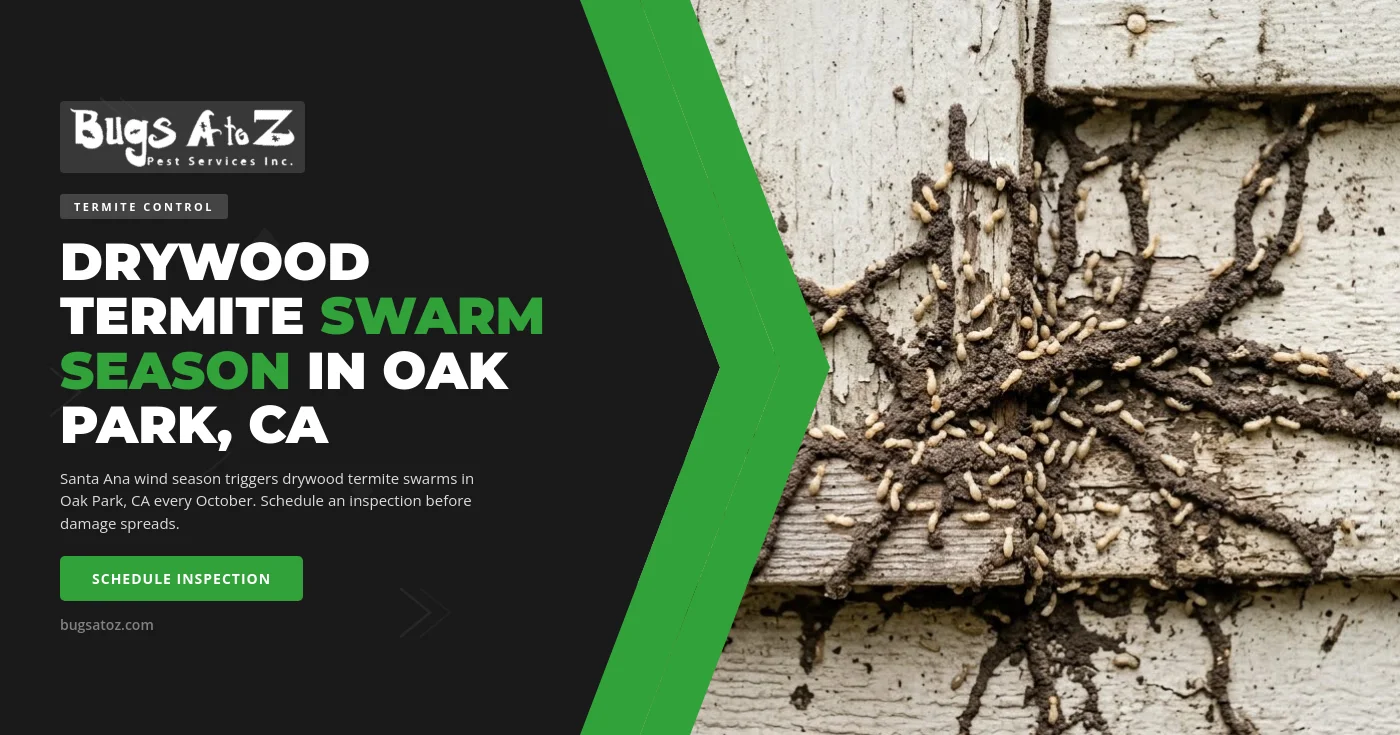
Why October Santa Ana Winds Trigger Drywood Termite Swarms in Oak Park, CA
Every October, the first hot Santa Ana wind event of the season rolls across the western San Fernando Valley and the Conejo corridor, and within a day or two, the phone starts ringing. A homeowner finds a pile of identical smoky, translucent wings on a windowsill, or notices what look like tiny coffee grounds collecting under a garage beam. For foothill communities like Oak Park — set against the Simi Hills next to Agoura Hills — October is the single busiest drywood termite swarm month of the year.
At Bugs A to Z, we handle termite control as one of our highest-volume fall services across Oak Park, Agoura Hills, Westlake Village, and the surrounding western Valley and eastern Ventura County communities. This guide walks through why Santa Ana wind season triggers drywood swarms, how to tell a termite swarmer from a flying ant, what the early damage signs look like, which prevention habits actually matter, and what a professional treatment plan covers. For a broader look at our full range of services, visit the Bugs A to Z homepage.
Why Santa Ana Winds Signal Termite Swarm Season in Oak Park, CA
Santa Ana winds are the single biggest climate driver behind October drywood termite activity in Oak Park. These are the hot, dry downslope winds that originate over the Great Basin, compress and heat as they drop through the Sierra Pelona and Santa Susana passes, and accelerate westward into Ventura County. By the time they reach Oak Park, a foothill community bordering the Simi Hills near Agoura Hills, temperatures climb into the 90s, and relative humidity drops below 15 percent for days at a stretch.
That combination of radiant daytime heat and bone-dry air is exactly what western drywood termite colonies wait for. According to UC Integrated Pest Management's guidance on drywood termites, drywood termites swarm on warm days in late summer and fall. In our own experience across Oak Park, the warm afternoons of Santa Ana events tend to trigger the largest single-day flights. A colony that has been quietly developing inside a rafter or garage beam for three to five years finally releases its reproductive alates, and those swarmers ride the wind until they find a crack in another piece of dry wood downwind. With wood-framed homes set against chaparral-covered foothills, Oak Park sees steady swarm activity every October in our experience.
What Are Drywood Termites and Why Do They Target SoCal Homes?
The western drywood termite (Incisitermes minor) is California's second most economically damaging termite species after subterraneans, and the Southern California coastal and foothill belt sits at the center of its range. Unlike subterraneans, drywood termites do not need soil contact and do not build mud tubes along foundations. A single mated pair only needs a hairline crack in dry, sound wood somewhere above ground to establish a new colony, and that colony then lives its entire life cycle inside the wood it eats.
Colony growth is slow at first. A new pair produces only a few dozen offspring in the first year, and it takes three to five years before the colony is large enough to release its own reproductive swarmers. During that development window, the colony is almost invisible from outside the wood. By the time a homeowner sees the first pile of shed wings on an Oak Park windowsill, the colony has already been active in the structure for years — and the swarm is the colony's signal that it is now large enough to seed new colonies in neighboring beams or detached structures. Ignoring that first swarm often leads to multiple active colonies on the same property within a few years.
How to Spot Flying Termites Around Your Oak Park Property
Most homeowners who call us during Santa Ana wind season have already spent ten minutes trying to decide whether the insects on the patio screen are termites or flying ants. The body design is different enough to settle with a hand lens and good light.
- Wings. Termite alates have four wings of equal length, longer than the body, with a dark vein running along the leading edge. Flying ants have two long forewings and two shorter hindwings.
- Waist. Termites have a thick, straight waist. Ants have a pinched, wasp-like waist.
- Antennae. Termite antennae are straight and beaded. Ant antennae bend at a clear elbow.
- Color. Western drywood swarmers are dark brown to reddish-brown with smoky wings. Carpenter ant swarmers in our area are solid black or black-and-red.
- Where they land. Drywood swarmers are weak fliers and pile up against the first bright surface they hit — sliding door tracks, west-facing windowsills, patio light fixtures, and skylights.
- Wing piles. Drywood termites shed all four wings within hours of landing. The diagnostic finding is often a scattered pile of identical smoky, translucent wings on a windowsill the morning after a swarm.
Equal-length wings, straight waist, beaded antennae — that is a termite swarm. Bag a few of the shed wings in a plastic sandwich bag and keep them; species identification is the first question we will ask on the call.
Signs of Drywood Termite Damage in Your Attic and Walls
Because drywood termites live their entire lives inside the wood they eat, the colony itself is almost never visible from outside the beam. What you will see is the daily byproduct of its feeding and housekeeping. These are the signs we walk every Oak Park termite inspection for.
- Frass pellets. Drywood frass is the single most diagnostic finding in the industry. Pellets are roughly 1 millimeter long, hard, dry, and hexagonal with six concave sides under magnification. Color ranges from light tan to dark brown depending on the wood species the colony is feeding on. Pellets accumulate in small conical piles directly below an active gallery.
- Kick-out holes. Drywood termites chew small openings — under 2 millimeters across — through which they push accumulated frass out of the gallery. The holes are often plugged with a dark spot of compacted pellets homeowners mistake for a knot or nail hole.
- Discarded wings. Piles of identical smoky, translucent wings on windowsills, inside sliding door tracks, and around light fixtures after a swarm.
- Hollow-sounding wood. Tap a suspect beam with the handle of a screwdriver. Drywood-galleried wood produces a papery sound next to the dull thud of sound lumber.
- Blistering or sunken paint. When a gallery runs close to the painted surface of exterior trim, the wood loses structural integrity and the paint develops blisters, sunken patches, or small cracks that do not match normal weathering.
Pellet piles below a suspect beam and discarded wings inside the structure are the two findings that most often change a treatment plan — either one means the colony is actively producing and the inspection needs to extend into every piece of connected framing.
DIY Termite Prevention vs. Professional Treatment in Oak Park
Hardware stores across the western Valley sell every category of over-the-counter termite product, and some of them do have a legitimate role in prevention. Understanding what each category can and cannot do saves months of wasted effort on the wrong tool.
What helps for prevention. Keeping paint and stain current on every exterior wood surface closes the hairline cracks a swarming pair uses to establish a colony — focus on south- and west-facing eaves, fascia, rafter tails, and trim where Santa Ana exposure is highest. Replacing worn attic and gable vent screening with 1/16-inch hardware cloth blocks swarmers from flying directly onto rafters during peak swarm afternoons. Moving firewood, scrap lumber, and dead tree limbs away from the house eliminates satellite colony sites. None of this requires a professional, and all of it should be routine maintenance on any Oak Park home built before 2000.
What generally does not work. Over-the-counter aerosol termite sprays and foggers are the most common mistake. Surface sprays cannot reach termites living inside sealed galleries three to six inches deep in a beam, and foggers contain no termiticide capable of penetrating wood. Spot "injection" products sold at hardware stores work only when the exact gallery location is known with precision, which is almost never the case without a trained inspection. For anything beyond a single visible kick-out hole in a readily accessible beam, DIY treatment typically consumes a season of effort while the colony continues to feed and expand. A professional inspection costs a small fraction of what it takes to replace a single bay of damaged rafter framing.
How Bugs A to Z Treats Drywood Termites in Oak Park, CA
Effective professional drywood termite control is built around three coordinated steps: a thorough inspection, species confirmation and gallery mapping, and a treatment plan matched to how widespread the activity actually is. Skipping any one of them is where most treated homes end up with recurring activity.
Inspection comes first and is far more than a flashlight sweep of the garage. Our standard Oak Park inspection follows a fixed sequence so nothing gets missed. Outside, we walk the full perimeter of the home and any detached structures — eaves, fascia, rafter tails, window and door frames, garage door jambs, exposed beams, patio covers, and fences all get probed for frass, kick-out holes, and discarded wings. In the attic, we check the ridge board, rafters, collar ties, top plates, and the back side of the fascia and gable vents. The interior walkthrough covers door and window frames, baseboards, and any exposed beams. Every finding gets photographed and mapped so the homeowner can see exactly where the activity is and what the treatment scope needs to cover.
Treatment selection depends on how widespread the activity turns out to be. A small, localized colony confined to a single beam, fascia run, or garage header can usually be addressed with a spot treatment — direct injection of borate or non-repellent termiticide into the galleries through the kick-out holes, paired with a borate surface application to seal the surrounding wood. Spot treatment only works when the inspection has confidently mapped every active gallery. When drywood activity is widespread across the structure or hidden in framing we cannot access from outside the wood, the only treatment with documented whole-structure efficacy is fumigation with sulfuryl fluoride — a 48-to-72-hour cycle that requires the household to vacate and that eliminates every colony in every piece of enclosed framing in a single pass. Follow-up visits in the months after treatment verify that no secondary activity emerges from satellite colonies in detached structures.
Scheduling a Fall Termite Inspection Before Damage Gets Worse
The ideal inspection window for an Oak Park property is early fall, before the first major Santa Ana event lifts the first wave of swarmers off the chaparral and into the eaves of nearby homes. A pre-swarm inspection catches any existing colony about to produce reproductives, and it confirms that attic and gable vent screening, exterior paint film, and other access-blocking details are tight before swarm pressure peaks.
A second inspection in late November or December, after the fall swarm window has closed, confirms whether any swarmers from the October flights landed and established new colonies. For Oak Park homes built before 1990 — which includes most of the original Oak Park Estates and surrounding tracts — this twice-yearly inspection cadence is the most cost-effective termite protection plan we recommend. The two inspections together cost dramatically less than the repair bill for a single bay of damaged rafter, and they typically identify emerging activity years before a homeowner would see a visible sign of damage.
If you have already found a pile of shed wings on a windowsill, pellets accumulating under a beam, or pinhole openings in a piece of trim, the right next step is a professional inspection rather than a wait-and-see approach. Drywood colonies do not resolve on their own, and every month of continued feeding translates directly into additional square footage of damaged framing. We serve Oak Park alongside Agoura Hills, Westlake Village, Calabasas, Thousand Oaks, Woodland Hills, and the surrounding western Valley and eastern Ventura County communities, with inspection, treatment, and seasonal prevention programs built around the drywood pressure this region sees every fall.
When Should I Schedule a Fall Drywood Termite Inspection in Oak Park, CA?
Contact Bugs A to Z for professional drywood termite control in Oak Park if you have found a pile of identical smoky, translucent wings on a windowsill after a Santa Ana event, noticed tan hexagonal frass pellets accumulating under a garage beam, spotted pinhole kick-out holes plugged with dark compacted pellets in exterior trim, heard a hollow papery sound when tapping a suspect rafter, or seen blistered paint on south- or west-facing fascia. Over-the-counter sprays cannot reach termite galleries three to six inches deep in a beam, and foggers contain no termiticide capable of penetrating wood. Our service begins with a full-perimeter inspection and attic walk to confirm the species and map every active gallery, then applies either targeted borate injection for localized colonies or whole-structure fumigation with sulfuryl fluoride for widespread activity, followed by exclusion at vent screening and paint-film gaps so new swarmers cannot establish next fall. Serving Oak Park, Agoura Hills, Westlake Village, Calabasas, Thousand Oaks, Woodland Hills, and the surrounding western San Fernando Valley and eastern Ventura County communities.