

Late-Spring Cockroach Control in Van Nuys, CA
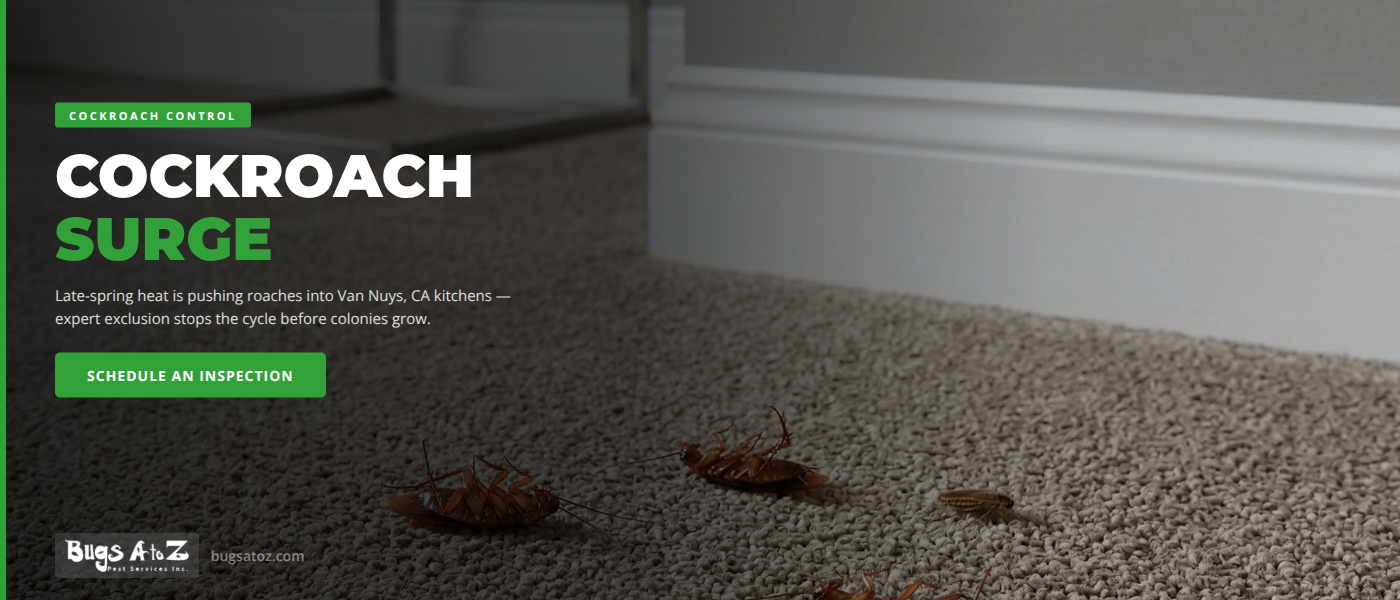
Late-Spring Cockroach Control in Van Nuys, CA
The first warm string of nights in Van Nuys always lights up our phone. A homeowner flips on the kitchen light at eleven, and a brown shape disappears under the dishwasher. A renter on Sepulveda opens the cabinet under the bathroom vanity and watches a cluster of tiny roaches scatter behind the P-trap. By late May, the calls stack up fast across the San Fernando Valley.
We are Bugs A to Z, and Van Nuys sits in the middle of our service map. This guide walks through why late-spring heat pushes cockroaches into Valley homes, how to tell which species you are dealing with, where they hide, the early signs that matter, the documented health risks, and the prevention work that stops the cycle. The last section covers how we approach professional cockroach control in Van Nuys.
Why Late-Spring Heat Triggers Cockroach Activity in Van Nuys
Cockroaches in the San Fernando Valley follow the thermometer. Through winter, the population is mostly hidden — eggs in cases waiting to hatch, adults sheltered behind warm appliances, and outdoor populations tucked into sewer lines, water meter boxes, and rock piles. As soon as daytime highs sit in the mid-eighties and nights stay above sixty, the egg cases start hatching and the adults resume aggressive foraging.
Cockroach activity peaks between 78 and 85 degrees Fahrenheit, and household sightings rise roughly 49% from March through June. That curve maps almost perfectly onto our Van Nuys call volume. Three local factors stack on top of the heat: the Valley's older housing stock with original cast-iron drain stacks and tile-on-slab kitchens; water everywhere a roach needs it from AC condensate lines, drip irrigation, and slow leaks under sinks; and dense apartment buildings with shared walls and plumbing that let a German cockroach population walk between units without going outside.
German vs. Oriental Cockroaches: Which Species Are Invading San Fernando Valley Homes
Almost every Van Nuys cockroach call we run is one of two species, and the treatment plan looks very different for each. According to UC IPM's cockroach pest notes, these account for the majority of Southern California household infestations.
- German cockroach (Blattella germanica). Small, light brown, under an inch long, with two dark stripes behind the head. Lives and breeds entirely indoors, hugging warm appliance motors and humid pockets. A single female can produce more than 30,000 descendants in a year — the fastest reproduction rate of the common pest species. When a Van Nuys homeowner sees roaches in the kitchen during the day, German is almost always the answer.
- Oriental cockroach (Blatta orientalis). Larger, around 1¼ inches, glossy black to dark brown. Prefers cooler, damper outdoor habitats — water meter boxes, drains, garages, ivy, and woodpiles — and migrates indoors looking for food, water, or shelter. Most stay on the ground floor and gravitate to bathrooms, laundry rooms, and garages rather than kitchens.
One important update for the Valley: UC IPM has documented that the Turkestan cockroach is steadily displacing the Oriental cockroach across Southern California. Turkestan adults can be told apart by cream-colored markings along the edges of their wing buds. The behavior overlaps with Oriental, so the prevention work is the same, but the identification matters for picking the right exterior strategy.
Where Cockroaches Hide in Van Nuys Kitchens, Bathrooms, and Laundry Rooms
Cockroach inspections in Van Nuys homes follow the heat, the water, and the food. We walk every job in the same order because the harborage points are predictable.
- Kitchen. Behind and under the refrigerator (the compressor runs warm year-round), the dishwasher, the cabinet hinges, the toe-kick under base cabinets, and the back of the microwave cavity. German cockroaches breed here because warm motors and food debris are everything they need.
- Bathroom. Under the vanity around the P-trap, inside the tub access panel, around the toilet supply line, and inside the slab penetration. Every species likes a bathroom because the humidity and water are reliable.
- Laundry room. Behind the washer and dryer, inside the dryer vent housing, and around the floor drain. Many Van Nuys homes have laundry rooms that share a wall with the kitchen, so a population behind the dishwasher can spread into the laundry within weeks.
- Garage and exterior. Around the water heater, in the gap where slab meets wall, inside the electrical panel, and along the perimeter near hose bibs and the irrigation manifold. Oriental and Turkestan roaches stage here before pushing indoors. Lift a water meter lid in Van Nuys at dusk and you will often watch dozens scatter.
The harborage map is the first thing we walk on every call. The single finding that changes a treatment plan most often is whether the population is indoor-resident or outdoor-pushing-in.
Early Warning Signs of a Cockroach Infestation You Shouldn't Ignore
Most Van Nuys homeowners who call us have already seen a live roach. The signs they missed were in plain view for weeks. These are the early indicators we look for.
- Pepper-fleck droppings. Small black or dark-brown specks that look like ground pepper or coffee grounds, concentrated along drawer corners, pantry shelf edges, and the toe-kick under cabinets. German cockroach droppings cluster — find a corner of grit and you have found the harborage.
- Smear marks. Long dark smudges along walls or behind picture frames where roaches travel the same path repeatedly. Common on warm walls behind the fridge or above the stove.
- Egg cases (oothecae). Light-tan to dark-reddish-brown capsules, roughly 1/4 to 3/8 inch long, glued into cabinet corners or behind drawer slides. A handful of egg cases means the population is reproducing on site, not just visiting.
- Shed skins and a musty, oily odor. Translucent papery casts accumulate in the same corners as the droppings. Mature German cockroach populations produce a distinctive odor that gets worse as numbers grow.
- Daytime sightings. Cockroaches are night-active. A roach in the open during the day means the harborage is full and the overflow is foraging when it normally would not. That is a "call now" sign — not a "watch and see" sign.
If any two of these turn up in the same room, the population is past the toe-hold stage, and the longer the call waits, the more eggs hatch into the next round of foragers.
Health Risks Cockroaches Bring Into Van Nuys Households
Cockroaches are not just a comfort problem. The EPA lists cockroach allergens among the most significant indoor asthma triggers, noting that proteins in droppings, saliva, and shed body parts drive a substantial share of asthma cases in urban regions. Children are more sensitive than adults, and Valley apartment buildings with chronic German cockroach problems show higher pediatric asthma rates.
Beyond allergens, cockroaches walk through drains, garbage, and sewer lines and then walk across food surfaces, where they can deposit bacteria associated with salmonella, staphylococcus, and streptococcus. They do not bite or sting, but the allergen and bacterial load is enough that the EPA's integrated pest management guidance is clear: cockroach populations in occupied homes should be controlled, not tolerated. The reason we push on cockroach calls in Van Nuys is the measurable health load on the people who live in the home — especially kids.
Five Late-Spring Steps to Roach-Proof Your Van Nuys Home
Late spring is the right time to do the prevention work that keeps the summer population from exploding. Walk the home with this list in hand and knock down what you can in one weekend.
- Seal kitchen and bathroom plumbing penetrations. Pull the dishwasher kick plate, the under-sink cabinet base, and the bathroom vanity. Caulk around every supply line, drain stack, and electrical penetration. Most Van Nuys cockroach harborages live in the half-inch gap around an old galvanized supply line.
- Fix every drip. A slow drip under the kitchen sink keeps a German cockroach population watered indefinitely. Replace worn supply hoses, tighten P-trap connections, and check the dishwasher drain fitting.
- Store food in sealed containers and empty the trash nightly. Cereal boxes, pet food bags, and open pantry containers are reliable food sources. Glass or hard-plastic containers with tight lids cut off the supply.
- Clean under and behind warm appliances. Pull the fridge and the stove twice a year, vacuum the coils and the floor beneath, and wipe the back wall. Grease and crumbs behind the stove are the highest-calorie food source most German roach populations find.
- Manage outdoor harborage. Trim ivy and dense ground cover back from the foundation, move firewood and mulch piles away from the slab, screen the dryer vent and crawl-space vents, and check that the water meter lid sits flush. Fewer outdoor staging points means fewer Oriental and Turkestan roaches pushing indoors as the heat climbs.
Every step is something a motivated homeowner can knock out in a Saturday. Our residential pest control customers in Van Nuys get this walkthrough on the first visit.
When to Call Bugs A to Z for Professional Cockroach Control
The line between "I can handle this" and "this needs a professional" is straightforward. A single live roach with no droppings, egg cases, or smear marks may be solved by sealing and sanitation. Any combination of droppings in two rooms, egg cases, daytime sightings, or the musty oily odor means the population is past the threshold where store-bought sprays will solve it.
Our process for cockroach control in Van Nuys starts with identification. We collect a sample, confirm the species, and walk the home end to end to map the harborage points. German cockroach work focuses indoors on cracks and crevices, bait gels for the active harborage, growth regulators to break the reproductive cycle, and follow-up visits to confirm the population is collapsing. Oriental and Turkestan work pushes the perimeter — exterior bait stations, granular treatment around the harborage zones, and sealing the entry points the homeowner did not know existed.
We service Van Nuys along with Sherman Oaks, Reseda, Encino, Tarzana, Lake Balboa, Panorama City, Northridge, and the rest of the San Fernando Valley. For an inspection, a species identification, or a treatment quote, reach us through our contact page.
Frequently Asked Questions About Cockroach Control in Van Nuys
Why am I seeing cockroaches in my Van Nuys kitchen all of a sudden?
Late-spring heat pushes cockroach populations out of dormancy and into active foraging. Egg cases hatch, adults leave hidden harborages, and a population that was invisible all winter starts showing up in the open. If the population is German cockroach, it has likely been growing behind a kitchen appliance for weeks before the first sighting — the roach you saw is almost never the only one.
How do I get rid of cockroaches in a San Fernando Valley apartment?
Apartment cockroach work is harder than single-family work because the population walks between units through shared plumbing and common walls. Treatment in one unit alone rarely solves the problem — the building needs a coordinated program with the property manager. We work with Valley owners on building-wide treatments that hit every adjacent unit, not just the one the renter called from.
What attracts cockroaches in Southern California homes?
Water and food, in that order. Cockroaches need water daily and can survive on very little food. The most common attractors we find in Van Nuys homes are slow plumbing leaks under sinks, condensation on cold-water lines in the wall, pet water bowls left out overnight, grease behind the stove, and open pantry containers. Removing the water source is often more effective than removing the food source.
Are over-the-counter cockroach sprays enough to handle an infestation?
For a single sighting in an otherwise clean home, sealing and sanitation usually solves the problem. For a population with droppings, egg cases, or daytime sightings, over-the-counter sprays kill the visible roaches and scatter the rest — often making the infestation harder to find later. Bait gels and growth regulators applied at the right harborage points are the tools that actually collapse a German cockroach population, paired with the sealing and sanitation work above.