

Mosquito Control in Panorama City, CA: Why Invasive Aedes Mosquitoes Still Bite in November
Mosquito Control in Panorama City, CA: Why Invasive Aedes Mosquitoes Still Bite in November
If you’re still swatting at your ankles on the patio in November, you’re not imagining it. Small black-and-white mosquitoes keep biting across the Valley long after summer ends, and the first fall rains can give them a fresh start. That’s why mosquito control in Panorama City doesn’t stop when the calendar flips to autumn.
Invasive Aedes mosquitoes have changed what “mosquito season” means in Los Angeles. They bite during the day, breed in tiny amounts of water and leave behind eggs that can wait out the cooler months. A warm November afternoon after a storm is exactly the kind of weather they take advantage of.
Here at Bugs A to Z, we hear the same question every fall: why are mosquitoes still biting in November in Los Angeles? In this post, we explain what’s going on, how to recognize the invasive species, why rain-filled pots and saucers matter, what to clean up before winter and how a professional yard treatment fits alongside the free services your local vector control district provides.
Why Mosquitoes Are Still Active in Panorama City in November
Most of us grew up thinking of mosquitoes as a summer problem. In Southern California, that picture is out of date. Local reporting citing vector control officials notes that peak mosquito season in Los Angeles County typically runs from June through November, and that mosquitoes are becoming more of a year-round issue than a short seasonal nuisance.
A few things keep them going this late in the year:
- Warm days. Valley afternoons in November are often still mild, sometimes in the 70s, which lets larvae keep developing.
- Early storms. The rainy season usually begins somewhere between late October and November, refilling containers that dried out over summer.
- Irrigation. Sprinklers and drip lines keep saucers, drains and low spots wet even between storms.
- Little hard frost. Much of the Valley sees little or no hard frost, so there’s no sharp cutoff that ends the season overnight.
Activity does slow as nights get cooler and days get shorter. But slower isn’t the same as stopped. A run of warm days after rain can produce a new batch of biting adults in roughly a week or two, depending on temperature.
It also helps to know which mosquito is biting you. The mosquitoes most associated with West Nile virus in Los Angeles County are Culex species, which tend to bite around dusk and overnight. The ones nipping at your ankles at lunchtime belong to a different group entirely, and they’re the focus of this post.
Meet the Invasive Aedes Mosquito: Small, Striped and Biting by Day
Two invasive species have spread through Los Angeles County in recent years: Aedes aegypti, the yellow fever mosquito, and Aedes albopictus, the Asian tiger mosquito. The California Department of Public Health tracks both species and where they’ve been detected in the state.
How to Recognize Them
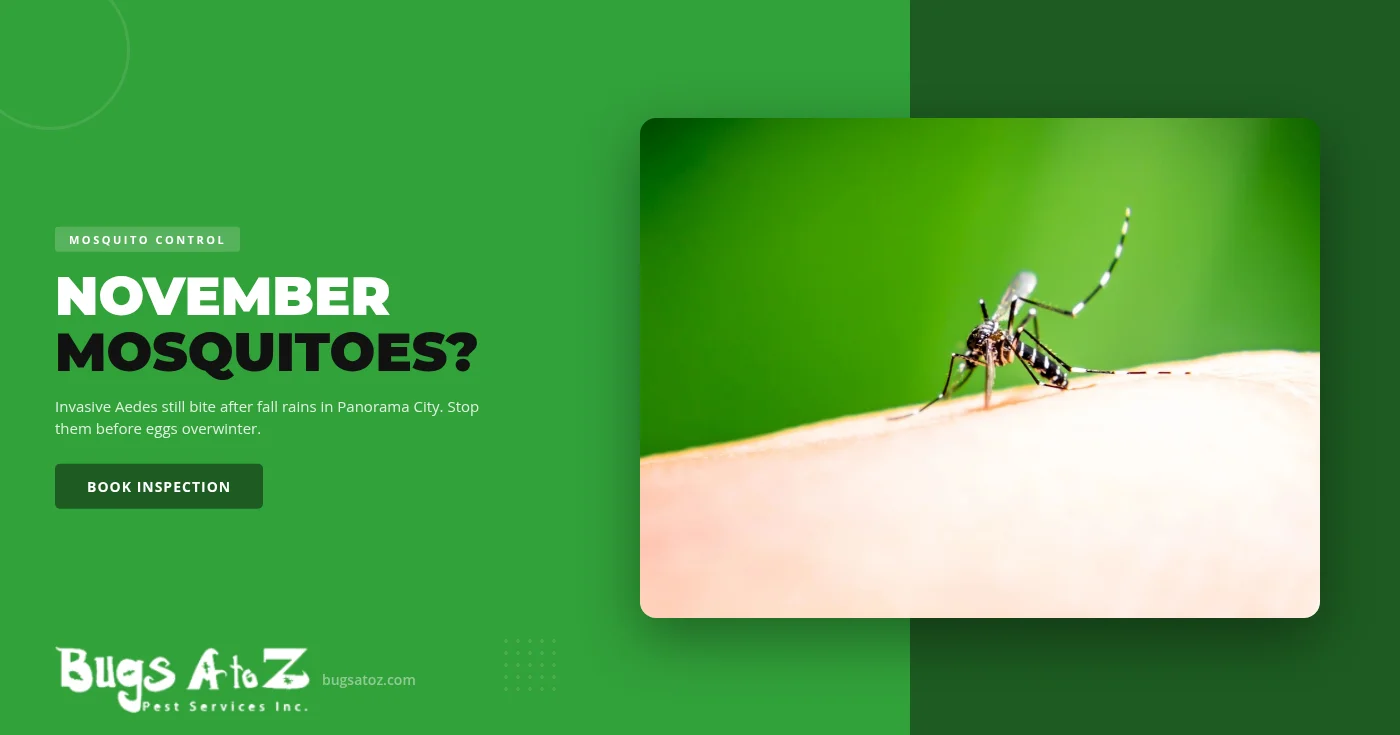
Both are small, often smaller than people expect, and dark black with bright white markings on the legs and body. Signs you’re dealing with Aedes rather than a typical evening mosquito include:
- Bites during daylight, especially mornings and late afternoons
- Bites around the ankles and lower legs, which is why many people call them “ankle biters”
- Quick, darting flight that makes them hard to swat
- Clouds of them hiding in shady ground cover, under patio furniture and along fences
Why They Matter
These day-biting mosquitoes are aggressive, and they arrived through global shipping and the plant trade. Beyond the itchy bites, they’re considered potential carriers of viruses such as dengue, Zika and chikungunya in parts of the world where those viruses circulate. We don’t want to overstate that risk: public health agencies monitor for local transmission, and the main reason most homeowners call us is simply that the bites make it hard to enjoy the yard.
What makes them so successful in Valley backyards is how little they need. They don’t require ponds or marshes. A bottle cap’s worth of water can be enough.
How the First Fall Rains Refill Hidden Breeding Spots Around Panorama City Homes
Here’s the part that catches people off guard. Over the summer, many containers dry out. Female Aedes mosquitoes lay their eggs on the inside walls of containers, just above the waterline, and those eggs can survive dry for months. When the first fall storm refills the container, the water reaches the eggs and they hatch.
That means a dry yard in October isn’t necessarily a clean yard. The eggs may already be there, waiting for rain.
Common Spots We Find After Rain
- Plant saucers and decorative pots without drainage holes
- Clogged rain gutters and downspouts
- Tarps over grills, boats and woodpiles
- Children’s toys, buckets, wagons and wheelbarrows
- Bromeliads and other plants that hold water in their leaves
- Pet bowls and birdbaths left outdoors
- Old tires, valve boxes, drains and low spots on patios
Because these mosquitoes usually don’t travel far from where they hatch, often just a few hundred feet, the source is typically on your own property or a neighbor’s. That’s actually good news. It means what you do in your own yard makes a real difference. In neighborhoods where yards back up to one another, a few neighbors cleaning up together can make an even bigger impact.
Aedes Eggs That Survive Winter: Why Fall Cleanup Matters for Next Spring
It’s tempting to assume winter will take care of the problem. It won’t, at least not completely. Adult activity drops as temperatures fall, but eggs stuck to container walls can carry over to spring. When the weather warms and water returns, they hatch and the cycle starts again.
Dumping Water Isn’t Enough
Tipping out a saucer removes larvae, but it doesn’t remove eggs glued to the inside surface. To actually get rid of them:
- Tip out any standing water.
- Scrub the inside walls with a stiff brush, paying attention to the old waterline.
- Rinse, then let the container dry or store it upside down.
- Repeat after every rain.
This is why fall is one of the best times to treat a yard for mosquitoes. You’re breaking the cycle before eggs overwinter instead of chasing biting adults next spring. Overwintering eggs are one of the main reasons the same homes see problems year after year, and it’s what makes fall mosquito control in the San Fernando Valley so worthwhile.
A November Yard Checklist: Pots, Saucers, Gutters, Toys and Tarps
Set aside 15 to 20 minutes after each rain and about once a week in between. Here’s what we suggest.
Plants and Pots
- Empty and scrub saucers, or fill them with sand so water can’t pool
- Flush bromeliads with a hose weekly
- Raise pots on feet so they drain freely
- Drill drainage holes in decorative containers
Gutters, Drains and Tarps
- Clear leaves from gutters so they don’t hold water
- Pull tarps tight or reshape them so rain runs off
- Check downspouts, French drains and valve boxes for standing water
Toys, Tools and Everything Else
- Flip buckets, wagons and kiddie pools upside down
- Store tires under cover
- Change and scrub pet bowls and birdbaths at least weekly
- Cover rain barrels with fine mesh
Personal protection still matters while you work outside. Public health agencies generally recommend EPA-registered repellents containing DEET, picaridin or oil of lemon eucalyptus, used according to label directions, along with long sleeves and pants during daytime yard work.
If you’ve done all of this and you’re still getting bitten, the source may be a spot that’s hard to see, or it may be next door.
How Professional Mosquito Control Treats Resting Areas and Breeding Sites
Here at Bugs A to Z, we approach mosquitoes the way we approach any pest: find out where they’re coming from, then target that source. Our work is built on Integrated Pest Management, which combines inspection, habitat reduction and targeted treatment rather than relying on spraying alone.
What a Yard Visit Includes
A yard mosquito treatment in Panorama City, CA typically starts with a walk-through of your property. From there, we focus on:
- Breeding sites: containers, drains, irrigation issues and hidden water you may have missed
- Resting areas: shady shrubs, ground cover, fence lines and the undersides of decks and patio furniture, where adult Aedes rest between bites
- Water that can’t be removed: where appropriate, a targeted invasive mosquito treatment for features that have to stay wet
- Recommendations: simple changes that keep water from collecting after the next storm
We use products according to label directions and talk with you about kids, pets and gardens before any treatment, so you have peace of mind about what’s being applied and where.
Working Alongside Vector Control
Professional service doesn’t replace your local vector control district. The Greater Los Angeles County Vector Control District offers free public services, including mosquito surveillance and responding to resident service requests; check the district’s website for current options. We see our work as a complement: the district focuses on community-wide monitoring, and we focus on the details of your property. Many customers pair a seasonal mosquito visit with our residential pest control so the home and yard stay covered through the cooler months.
Frequently Asked Questions About Late-Season Mosquito Control in Panorama City
Why are mosquitoes still biting in November in Panorama City?
Mild daytime temperatures, early fall rains and ongoing irrigation keep breeding sites wet and warm enough for larvae to develop. Invasive Aedes species also bite during the day, so you notice them while you’re outside in the afternoon.
Does cold weather kill mosquito eggs in the Valley?
Not reliably. Hard frosts are uncommon in much of the Valley, and Aedes eggs can survive dry for months on container walls. Cooler weather slows adults down, but eggs can carry over to spring, which is why scrubbing containers in fall matters.
Are these mosquitoes dangerous?
For most households, they’re mainly a biting nuisance. They are potential carriers of viruses such as dengue and Zika where those viruses circulate, so public health agencies watch them closely. If you have health concerns, follow guidance from your county health department and your doctor.
How do you protect kids and pets during a treatment?
We discuss your household before we start, apply products according to label directions and let you know how long to keep children and pets off treated areas. Our goal is effective, pet-friendly protection with as little product as the situation calls for.
How often should I check my yard after rain?
A good rule of thumb is a quick walk-through after each storm and about once a week otherwise. Tip, scrub and dry anything holding water.
Book Mosquito Control in Panorama City Before Winter Sets In
November mosquitoes aren’t a fluke. They’re a sign that eggs are hatching in rain-filled containers nearby, and that more may be waiting for spring. A little cleanup now, paired with a targeted treatment, means fewer bites this fall and a quieter start to next season.
When you’re ready for mosquito control Panorama City homeowners can count on, contact Bugs A to Z to schedule a yard inspection. We serve homes and businesses throughout Los Angeles and Ventura County, and we’ll help you find the source and stop it before the next storm rolls in.
Who Can Help Me Stop Mosquitoes That Keep Biting After the Fall Rains?
We can. Here at Bugs A to Z, we help homeowners and businesses across Los Angeles and Ventura County deal with the invasive, day-biting mosquitoes that hang around long after summer. When the first fall storms refill pots, saucers and gutters, we know exactly where to look.
Our mosquito control service is built around finding the source, not just knocking down the adults you can see. Here’s what you can expect when we visit:
- A thorough yard inspection of containers, drains, gutters, irrigation and plants that hold water
- Targeted treatment of resting areas like shady shrubs, ground cover and the undersides of decks and furniture
- Attention to breeding sites that can’t simply be dumped, treated where appropriate
- Practical advice on scrubbing containers and preventing eggs from carrying over to spring
- A conversation about your household, including kids, pets and gardens, before we treat
We follow an Integrated Pest Management approach, combining inspection, habitat changes and careful product use for lasting results with peace of mind. Our work complements the free services offered by your local vector control district, so your property gets the detailed attention it needs while the district watches the wider community.
If ankle bites are keeping you indoors this fall, reach out to us to book your yard inspection. We’ll help you break the cycle now so next spring starts with fewer mosquitoes.