

Why Aggressive Day-Biting Mosquitoes Are Showing Up in Reseda, CA Backyards This Spring
Why Aggressive Day-Biting Mosquitoes Are Showing Up in Reseda, CA Backyards This Spring
The first call we get every spring in Reseda is almost always the same: someone has been bitten in their own backyard at two in the afternoon. They were watering plants, grilling, or watching kids in the pool, and a pack of small black-and-white mosquitoes came at their ankles in broad daylight. That is not the Reseda our older customers remember. Mosquito control in Reseda, CA has changed dramatically in the last ten years, and the reason is sitting in your potted plant saucers right now.
At Bugs A to Z, we serve Reseda and the rest of the northwest San Fernando Valley, and our mosquito calls now run from late February through Thanksgiving. This guide covers what changed, where invasive mosquitoes are breeding around your home, the disease risk LA County families now carry, the five backyard steps that move the needle, and when it is worth calling a professional.
Why Reseda Mosquito Season Is Starting Earlier and Lasting Longer
The mosquito calendar in Reseda used to follow a predictable arc — nuisance mosquitoes appeared after the first warm rains in April or May, peaked through July and August, and faded once the nights cooled in October. That is no longer the pattern we see on the route.
Three forces have rewritten the schedule. Invasive Aedes mosquitoes — non-native species that do not need a true wet season to breed — mean a single warm week in February can launch the year. Longer warm seasons in the Valley extend the active window on both ends; we run treatments well into November. And the small-water breeding habits of these invasive species mean even a dry winter does not reset the population — a forgotten saucer is enough to keep a backyard generation rolling.
Mosquito control in Reseda has shifted from a summer concern to a nearly year-round one. Waiting for the first hot week in June means the first generation of Aedes is already feeding in the yard.
Invasive Day-Biting Mosquitoes in the San Fernando Valley
For most of the twentieth century, the mosquitoes biting Reseda backyards were native Culex species — dusk-and-dawn feeders that were a nuisance more than a serious threat. That has changed.
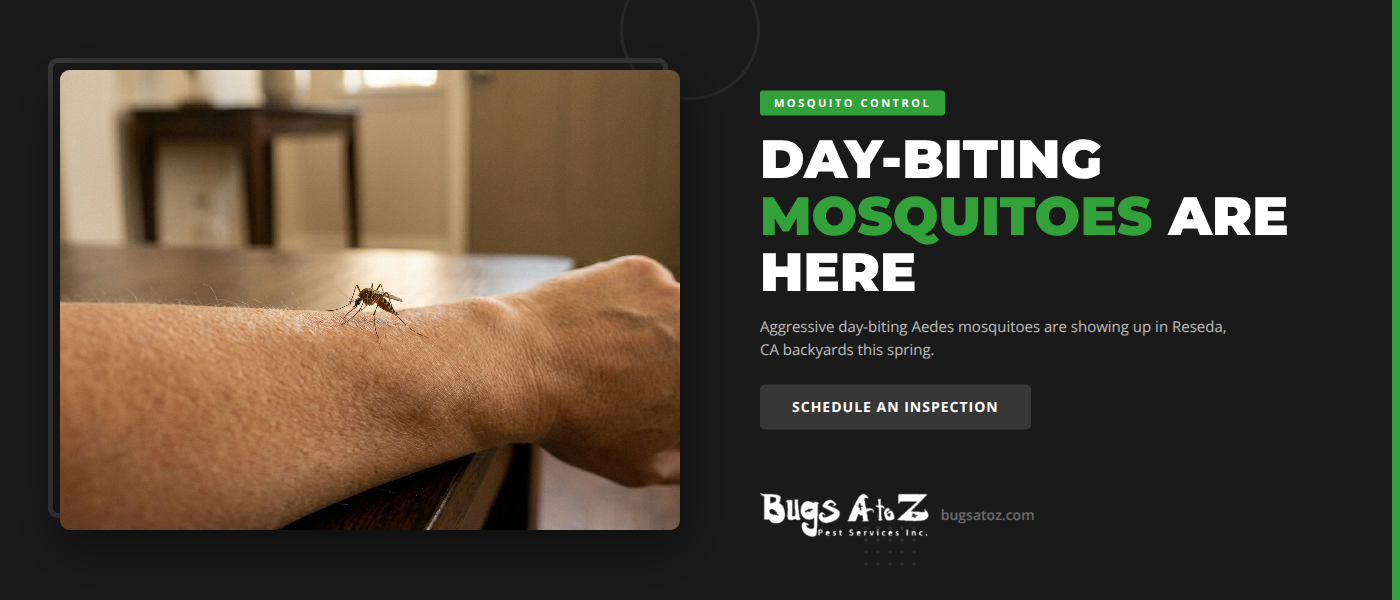
The two species rewriting the rules across Southern California are Aedes aegypti (the yellow fever mosquito) and Aedes albopictus (the Asian tiger mosquito). Both established in California in 2011 and are now widespread in the San Fernando Valley. They are small black mosquitoes with bright white stripes on the legs and thorax — roughly half the size of the native Culex.
The biggest behavioral difference is when they bite. Invasive Aedes are aggressive day biters — most active in the morning and late afternoon, with plenty of bite reports from noon to three. They target ankles and lower legs first, which is why local agencies nickname them "ankle-biters." The San Gabriel Valley Mosquito and Vector Control District has documented their rapid spread across LA County.
Where Mosquitoes Breed Around Reseda, CA Homes
When we walk a Reseda property for the first time, we find a mosquito breeding site within ten minutes about ninety percent of the time. Invasive Aedes are not the same animal as the Culex mosquitoes most longtime residents remember. Culex needs a real water body. Aedes can complete a generation in a teaspoon, and they prefer small artificial containers over larger natural ones.
The most common backyard breeding sites we find around Reseda homes:
- Plant saucers and overflow trays — The number-one source on most Reseda lots. A generation of Aedes can hatch out before you next pick the pot up.
- Bromeliads and cup-leaved ornamentals — Common in Valley landscaping; they hold water in the leaf axils for weeks.
- Pet bowls, bird baths, and kid toys — Buckets, sand toys, and deflated rafts collect rain and irrigation overspray.
- Clogged gutters and downspouts — Two leaves and a tablespoon of water in a gutter elbow is enough.
- Tarps, trash can lids, and recycling bins — Any uneven surface that catches rain and does not drain.
- French drains and decorative fountains — When the outlet clogs or the pump stalls, the basin holds water indefinitely.
According to UC IPM guidance, the entire mosquito life cycle from egg to biting adult can complete in a week or less in summer water temperatures. Reseda summer heat pushes that timeline to the fast end of the range.
Health Risks Mosquitoes Bring to Los Angeles Families
The reason mosquito control matters more in Reseda than it did fifteen years ago is the disease profile of the invasive species. Native Culex carry West Nile virus, which remains a real risk for older adults and people with compromised immune systems.
What is new is the disease load that comes with Aedes. Aedes aegypti and Aedes albopictus are the world's primary vectors of dengue, chikungunya, and Zika. Until recently, LA residents only encountered those as travel cases. In 2025, locally acquired dengue cases were reported in both the San Gabriel Valley and the San Fernando Valley — patients who had not traveled and were bitten by a local mosquito carrying the virus. The number is small, but the trend has the attention of every public-health agency in the region.
For most healthy adults, a mosquito bite in Reseda is still an itchy nuisance and nothing more. For households with infants, pregnant family members, elderly relatives, or anyone who is immunocompromised, the calculus has changed.
Five Steps to Mosquito-Proof Your Reseda Backyard This Spring
For most Reseda homes, eighty percent of the mosquito problem comes from the property itself — meaning you have direct control over most of it. We give every customer the same five-step routine.
Step 1 — Walk the property after every irrigation cycle
Once a week, after the sprinklers run, walk the yard with a five-gallon bucket and tip out every saucer, bowl, toy, and forgotten container holding water. The whole loop takes ten minutes. If you do nothing else on this list, do this.
Step 2 — Treat water you cannot drain with Bti
Bird baths, fountains with broken pumps, and water features the household does not want to empty can be treated with Bacillus thuringiensis israelensis (Bti) — a naturally occurring bacterium that targets mosquito larvae and is gentle around fish, birds, pollinators, pets, and people. Mosquito dunks at any garden store work for about a month per dose.
Step 3 — Clean gutters and yard drains
Once in spring and once in fall, clear the gutters, downspouts, and any yard drain or French drain on the property. Standing water in a clogged gutter is hard to spot from the ground and one of the most productive sources for invasive Aedes.
Step 4 — Repair window and door screens
Adult mosquitoes follow the carbon dioxide and warmth of the house through any tear or gap. We see torn patio-slider screens constantly — a roll of screen patch tape closes most damage in five minutes.
Step 5 — Schedule a perimeter treatment before the season picks up
A targeted spring perimeter treatment knocks down the first generation of adults before they finish breeding. We focus on resting harborage — the underside of patio furniture, dense ornamental plantings, fence lines, and shaded areas around AC units — rather than blanketing the lawn.
Why Citronella and DIY Sprays Fall Short in SoCal Heat
Every Reseda hardware store has a wall of mosquito products — citronella candles, plug-in repellers, ultrasonic stakes, fogging machines, and a half-dozen "kills mosquitoes" aerosols. The problem is not that they do nothing; it is that they do not solve the underlying issue.
- Citronella candles — Effective only in dead-still air within a foot or two of the candle. Any breeze and the protective zone collapses.
- Bug zappers — Counterproductive. They kill far more beneficial insects (including dragonflies) than mosquitoes, which generally are not attracted to UV light.
- Ultrasonic repellers — Peer-reviewed studies show no measurable effect on mosquito biting behavior.
- Hardware store fogging — Works for a few hours of patio use, then dissipates. Without source reduction, the population rebuilds within days.
- Backpack pyrethroid sprays — Knock down adults on contact but do not reach the larvae in saucers and gutters that produce next week's adults. Repeated misuse drives resistance in local Aedes populations.
The piece these tools all miss is that mosquito control in Reseda is a larva problem first and an adult problem second. Spending money on adult control while saucers and gutters keep producing new generations is a treadmill — eliminate the breeding source first, treat resting harborage second, and use adult fogging only when a yard event demands it.
When to Call a Reseda, CA Mosquito Control Pro
Most Reseda households can keep nuisance pressure manageable with the five backyard steps above. We get the most mileage on properties where:
- Bites are happening in the daytime — a strong indicator of invasive Aedes that backyard tipping alone may not control
- The yard backs onto a greenbelt, drainage easement, the LA River, or an undeveloped slope producing mosquitoes the homeowner cannot reach
- A neighboring property has standing water — an unmaintained pool, a neglected fountain, a junk pile — the homeowner cannot fix directly
- Dense landscaping (bromeliads, mature hedging, jasmine walls) gives adults far more harborage than a typical lot
- A household member has a medical reason to keep mosquito exposure as low as possible
- An outdoor event is on the calendar and the family wants peace of mind for the day
Our process for mosquito control in Reseda, CA starts with a property walk to map breeding sources and harborage. We tip standing water, treat anything that cannot be drained with Bti, and apply a targeted residual to resting zones. Most Reseda customers fold mosquito service into our broader residential pest control program once the first treatment is in place — that gives us a monthly baseline and catches new breeding sources before a generation gets out.
We serve Reseda along with Northridge, Granada Hills, Tarzana, Encino, Lake Balboa, Van Nuys, and Woodland Hills. To schedule a yard inspection, reach us through our contact page.
Frequently Asked Questions About Mosquito Control in Reseda, CA
When does mosquito season start in Reseda?
With invasive Aedes now established in the San Fernando Valley, the season effectively starts during the first warm week of February or March and runs through November. The historic April-to-October pattern is no longer reliable.
Why am I getting bitten in the middle of the day in my Reseda backyard?
Almost certainly Aedes aegypti or Aedes albopictus — invasive species that bite during daylight, target ankles and lower legs, and breed in small containers around the yard. They are not the dawn-and-dusk Culex mosquitoes longtime LA residents remember.
How small a water source does an Aedes mosquito need to breed?
As little as a teaspoon. A potted plant saucer, a bottle cap of irrigation overflow, or a tarp fold holding rainwater is enough for a generation to develop.
Are mosquito control treatments designed with families and pets in mind?
Yes. We use targeted residual products on resting harborage rather than broadcast lawn sprays. Bti, the larval treatment, is gentle around bees, fish, birds, and pets, and we coordinate timing so any contact treatment is dry before children or pets re-enter the yard.
How often should a Reseda yard be treated for mosquitoes?
For yards on our maintenance program, monthly treatments through the active season are standard. One-off treatments are useful around outdoor events, but the larva problem rebuilds within two to three weeks if breeding sources are not addressed.
Will a single treatment eliminate mosquitoes from my yard?
One treatment knocks down the existing adult population and any larvae we find on the walk-through, but it does not stop new mosquitoes from flying in from neighboring properties. Source reduction, Bti, and targeted residual treatment over the season is what produces lasting relief.