

Mosquito Control in Thousand Oaks CA
Mosquito Control in Thousand Oaks CA
Thousand Oaks sits at the edge of the Santa Monica Mountains, surrounded by oak woodland, riparian corridors, and the kind of landscape that makes Ventura County one of the most desirable places to live in Southern California. Those same natural features — the creek corridors, the seasonal water retention in oak groves, the irrigated residential landscapes — also create conditions that support mosquito breeding throughout the summer and into fall.
At Bugs A to Z, we provide professional mosquito control services in Thousand Oaks and throughout Ventura County. Understanding why mosquito activity peaks during summer and where to find the breeding sources in your yard is the foundation of effective protection — whether through DIY measures or professional treatment.
Why Mosquito Activity Peaks in Thousand Oaks Every Summer
Mosquitoes in Thousand Oaks don't follow a simple pattern driven by a single wet season. Ventura County's modified Mediterranean climate — with warm, dry summers and variable rainfall — creates mosquito activity driven primarily by human-managed water: irrigation systems, ornamental water features, swimming pools, and the stored water common on larger properties with multiple watering zones.
Summer heat accelerates mosquito development dramatically. At 90°F, a mosquito can complete its full life cycle — from egg to biting adult — in as few as seven to ten days. At cooler temperatures, the same cycle takes three to four weeks. This means that a small, unnoticed breeding source in July can produce several generations of mosquitoes before the end of summer — each generation larger than the last if the source isn't eliminated.
The Santa Monica Mountain foothills around Thousand Oaks also support significant wildlife populations, including deer, coyotes, and birds — all of which serve as hosts for mosquitoes and contribute to the density of local populations. Residents near Conejo Creek, the Arroyo Conejo, or any of the oak woodland riparian areas are particularly likely to experience elevated mosquito pressure during the warmest months.
California summers have also brought seasonal changes in mosquito species distribution. The Aedes aegypti (yellow fever mosquito) and Aedes albopictus (Asian tiger mosquito) — two invasive species established in parts of Southern California — are daytime biters, which extends the hours when Ventura County residents face mosquito exposure beyond the typical dawn and dusk peak windows of native species.
Common Mosquito Breeding Spots in Thousand Oaks Yards
Every mosquito that bites you began as an egg in standing water. Finding and eliminating standing water on your property is the single most impactful action a homeowner can take to reduce mosquito populations in their yard — before any treatment is applied.
Irrigation overspray and pooling — Drip irrigation zones that pool water around root systems, or spray heads that wet patio surfaces without proper drainage, create shallow standing water that mosquitoes exploit within 24 hours. Inspect your irrigation zones during operation and adjust spray heads or drainage to eliminate standing water accumulation.
Ornamental water features — Fountain bowls, decorative pots with standing water, bird baths, and small ponds without aeration or mosquitofish provide breeding habitat in close proximity to outdoor living areas. A still water feature as small as a saucer under a flower pot is adequate for mosquito breeding.
Gutters and downspouts — Clogged gutters hold water for weeks after rainfall or irrigation overspray. A single clogged gutter section can produce hundreds of adult mosquitoes per week during peak conditions. Clean gutters annually and ensure downspouts drain away from the structure without creating pooling at the base.
Tarps and covers — Pool covers with water pooled in depressions, tarps over equipment or furniture, and boat or vehicle covers with water collection are productive breeding sites that are easily overlooked.
Containers and debris — Empty plant pots, buckets, children's toys, old tires, and other containers that collect water are among the most productive mosquito breeding sites per unit of water because they retain heat and are often overlooked during inspections.
Irrigated ornamental beds — Dense ornamental ground cover — ivy, dichondra, ice plant — that retains moisture near the soil surface after irrigation provides resting habitat for adult mosquitoes during daylight hours and micro-standing-water conditions that support breeding.
Health Risks: West Nile Virus and Other Mosquito-Borne Concerns in Ventura County
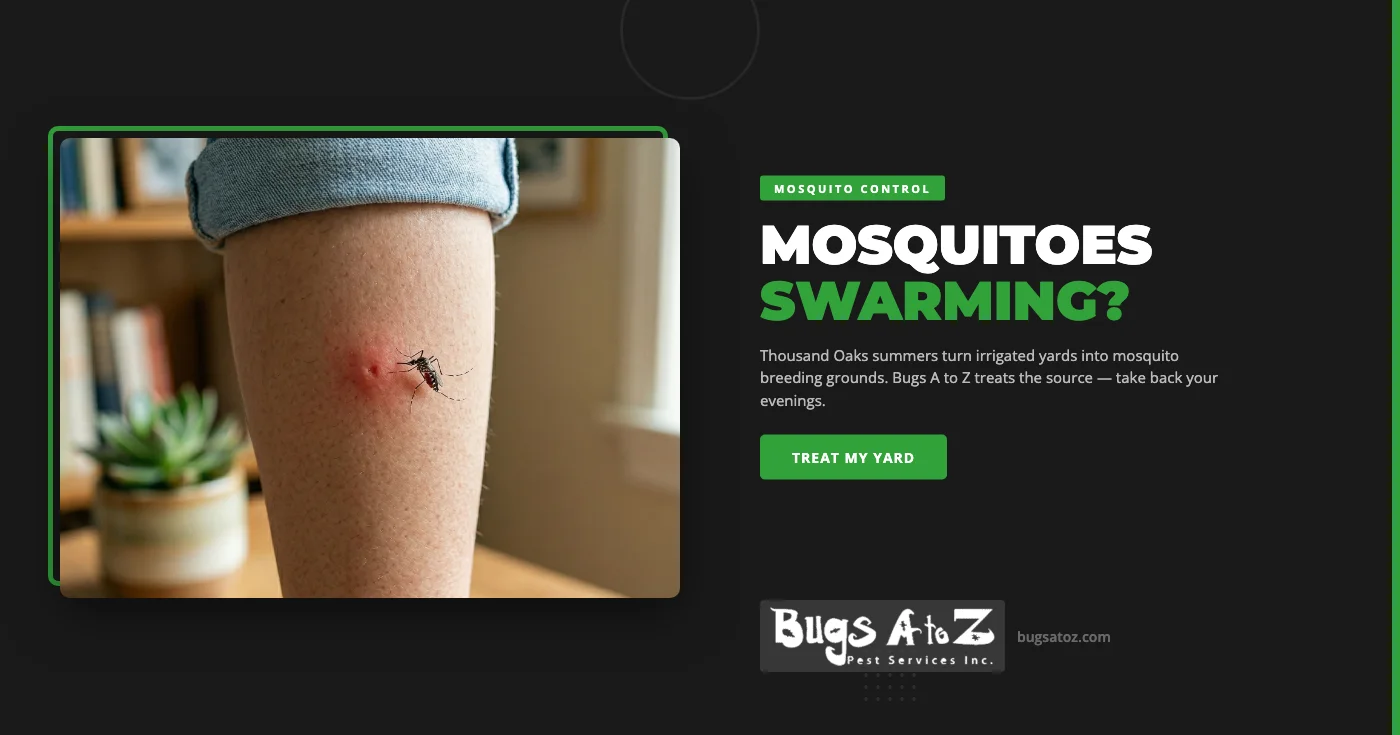
Most mosquito bites in Thousand Oaks result only in the familiar red, itchy welt that resolves within days. But the mosquitoes in Ventura County carry pathogens that represent a real health risk — and the risk isn't equally distributed throughout the population.
West Nile virus is the primary mosquito-borne disease concern in California. The Culex mosquito species — the common house mosquito and its close relatives — are the primary vectors in California, transmitting the virus from infected birds to humans. Most West Nile infections are mild and cause brief flu-like symptoms. However, approximately 1 in 150 people infected develop neuroinvasive disease — meningitis or encephalitis — which can cause permanent neurological damage or death. Older adults and people with certain medical conditions are at significantly higher risk for severe outcomes. Ventura County Vector Control monitors West Nile activity throughout the county and reports annually positive mosquito trap collections in the Conejo Valley area.
Saint Louis encephalitis, another virus transmitted by Culex mosquitoes, has also been detected periodically in Southern California. Like West Nile, it carries the highest risk of serious outcomes for older individuals.
The invasive Aedes species present in parts of Ventura County — Aedes aegypti and Aedes albopictus — are the vectors globally responsible for dengue fever, chikungunya, and Zika virus. While these diseases have not established transmission in California, their presence in the state underscores why monitoring and controlling invasive mosquito populations is a public health priority.
DIY Mosquito Prevention Tips That Actually Work
The most effective DIY mosquito prevention combines source reduction (eliminating standing water) with habitat management and targeted larvicide use.
Dump, drain, or cover any standing water at least once per week — this interrupts the breeding cycle before adults emerge. Pay particular attention after irrigation cycles and after any rainfall, as dry containers that weren't previously a concern become productive breeding sites within hours after collecting water.
For standing water that can't be eliminated — pond areas, decorative water features — use Bacillus thuringiensis israelensis (Bti) mosquito dunks, a biological larvicide that kills mosquito larvae without affecting fish, birds, or other wildlife. Mosquitofish, available free from Ventura County Vector Control for residents with ornamental ponds, consume mosquito larvae effectively in backyard water features.
Apply insect repellent containing DEET, picaridin, or oil of lemon eucalyptus during peak mosquito activity hours. In Thousand Oaks neighborhoods with Aedes invasive species, protection during midday and afternoon hours is also important, as these species bite throughout the day.
Install or repair window and door screens. Keep outdoor dining areas away from dense vegetation. Consider adding a fan to outdoor seating areas — mosquitoes are weak fliers and a direct fan creates an effective barrier against them in limited spaces.
When to Call a Professional Mosquito Exterminator
DIY measures are effective for source reduction but typically insufficient for eliminating established mosquito populations around properties with significant breeding pressure, wooded edges, or proximity to riparian corridors.
A professional treatment is worth considering if you're seeing significant mosquito activity despite eliminating visible standing water, if you have breeding sources you can't eliminate (drainage areas, neighboring properties, creek corridors), if you want protection for a specific outdoor event, or if you have household members for whom mosquito-borne illness risk is a particular concern.
Professional mosquito treatment targets adult mosquitoes in resting vegetation and applies larvicide to accessible standing water sources — a combination that provides faster population reduction than source reduction alone and maintains control over a treatment season.
How Bugs A to Z Treats Mosquitoes in Thousand Oaks and Ventura County
Bugs A to Z applies professional-grade mosquito treatments to the vegetation and landscape areas where adult mosquitoes rest during the day — the shaded undersides of leaves, dense shrubs, ground cover, and ornamental plantings. This residual barrier treatment reduces the adult population that would otherwise be active in your yard during evening and morning hours.
Our treatment also addresses accessible standing water sources on your property with larvicide, targeting mosquito breeding before adults emerge. We identify sources that may not be obvious during a homeowner inspection and provide specific recommendations for eliminating or treating those sources.
For maximum control during the summer season, we recommend a recurring treatment program on a 3-to-4-week cycle — aligned with the adult mosquito's lifespan and the new-generation emergence timeline. Single treatments provide meaningful short-term reduction but don't maintain control through the high-pressure summer period without follow-up.
Contact Bugs A to Z to schedule mosquito control services in Thousand Oaks and throughout Ventura County. We serve residential properties across the Conejo Valley with treatment programs designed for our region's specific mosquito species and summer conditions.