

Spider Control in Woodland Hills, CA: Widow Spiders Hiding in Garages and Holiday Decor Boxes This November
Spider Control in Woodland Hills, CA: Widow Spiders Hiding in Garages and Holiday Decor Boxes This November
Every November, garages across the west San Fernando Valley get busy. Ladders come down, bins slide off high shelves, and boxes of lights and wreaths untouched since last winter finally get opened. It’s also when many homeowners start searching for spider control Woodland Hills families can rely on, because those quiet boxes are prime shelter for western black widows and brown widows.
The good news is that widow bites are uncommon. According to the UC Statewide Integrated Pest Management Program, bites from black widow spiders are quite rare, even where these spiders are very common. Still, nobody wants to find a glossy black spider in the garland. Here at Bugs A to Z, we provide pest control in Woodland Hills and across the surrounding valley, and we know how unsettling that surprise can be.
Below, we cover why people and widows cross paths in late fall, how to identify them, where they hide in decor, how to unpack without a bite, and which garage fixes help.
Why Widow Spiders Move Into Woodland Hills Garages When November Nights Cool
Let’s be accurate about the headline: widow spiders don’t necessarily migrate indoors the moment the weather turns. UC IPM notes that the western black widow is found in populated areas almost everywhere in California, and around homes these spiders already live in garages, block walls, woodpiles and under patio furniture year-round. What changes in November is mostly us.
The west Valley is known for warm afternoons and noticeably cooler nights once fall settles in. A closed garage stays more sheltered than the yard, and the insects widows feed on gather around garage doors, porch lights and clutter along the walls. Spiders near that steady food supply have little reason to leave.
Then the holidays arrive. Decorations stored last December have usually sat undisturbed for about eleven months—dark, dry and full of corners, which is ideal shelter for a spider guarding egg sacs. When we pull those boxes down and reach in bare-handed, the chance of an encounter climbs. November isn’t necessarily when widows arrive; it’s when we finally go looking where they’ve been living all along. That’s the heart of smart fall spider prevention: focus on the places you’re about to disturb.
Black Widow vs. Brown Widow: Identifying the Spiders in Your Garage and Storage
UC IPM confirms there are two widow species in California: the western black widow and the brown widow. A third spider, the false black widow, is often mistaken for both.
The Western Black Widow
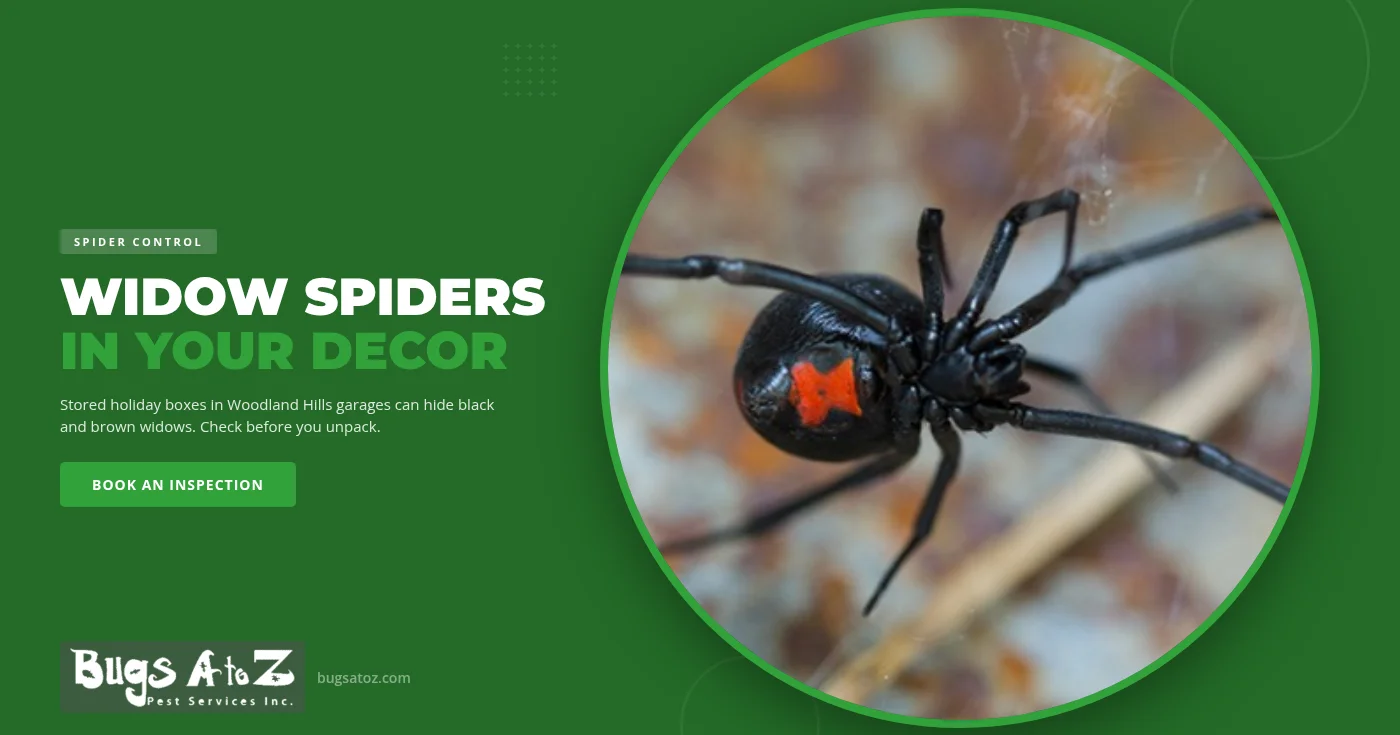
The adult female is glossy black and round-bodied, and she’s usually described as having a red hourglass on the underside of her abdomen. She hangs in a messy, tangled web in low corners, behind shelving or under workbenches. UC IPM notes that the silk of a mature black widow is very strong, so an unusually tough web in your garage is a clue. Males look quite different; unlike the female, the male keeps the juvenile’s coloring, so he’s smaller and paler.
The Brown Widow
Brown widows are mottled tan to brown and are commonly described as having an orange hourglass. The easiest clue is often the egg sac, generally described as spiky, like a small starburst, while black widow sacs are smooth. Brown widows are widely reported to have become common across Southern California and favor patio furniture, outdoor toys and bin handles. Spiky sacs in several spots are a strong sign you may need brown widow spider removal.
The False Black Widow
UC IPM describes this look-alike as chocolate brown and never red. Because it’s common in homes, it’s actually involved in more bite incidents than either true widow. The Pest Note includes a side-by-side comparison table worth a look.
The Holiday Decor Risk: Where Spiders Hide in Stored Boxes, Lights and Wreaths
Holiday decorations are practically built to shelter spiders: dark storage, tangled materials and months without disturbance. These are the spots that deserve the closest look:
- Cardboard flaps and handle holes: Gaps where flaps don’t meet make easy entry points.
- Coiled light strands: Loops of wire create dozens of protected pockets for webs.
- Wreaths and garland: Dense faux greenery and pinecones hide webs and egg sacs.
- Artificial trees: Folded branches near the base and the inside of the stand are favorite spots.
- Inflatable lawn decor: Folds in deflated fabric stay dark and still for months.
- Bin handles and lid rims: Even sealed bins have recessed handles where brown widows tuck in.
Pay special attention to egg sacs. UC IPM notes that a female western black widow typically lays about 300 eggs per sac. Removing sacs before decor comes indoors helps keep a new generation from hatching in your garage, or in your living room.
Boxes stored on the floor or against a wall are more exposed than those on raised shelving. If your decor sits in a corner that already has webs, give every box a careful check before you open it.
How to Unpack Holiday Decorations Without a Spider Bite
Learning how to check holiday decorations for black widow spiders takes only a few extra minutes. Here’s the routine we recommend:
- Wear thick gloves and long sleeves. Never reach into a box or behind a shelf bare-handed.
- Move boxes into daylight. Open them on the driveway or patio, where webs are easier to see and nothing escapes into the house.
- Open with a tool. Use a broom handle to lift flaps and nudge contents before reaching in.
- Unwind lights and garland outdoors. Go slowly and check plugs, coils and clips.
- Inspect wreaths and tree sections from every side, including the back and base.
- Vacuum webs, spiders and egg sacs. Seal the bag or canister contents in a trash bag and put it in an outdoor bin.
- Repack into clean, tightly sealed containers before anything goes back on the shelf.
If someone in your household is bitten, stay calm and get proper medical guidance. Contact your doctor or California Poison Control for advice, and seek emergency care if symptoms feel severe. We’re pest professionals, not medical providers, so we leave bite care to the experts. If you can do so without risk, photographing the spider can help with identification.
Cutting Off the Food Supply: Crickets and Other Insects That Attract Spiders
Spiders go where the food is. A garage that attracts crickets, moths, silverfish, beetles and flies keeps widows well fed all winter, which is why spider and insect problems usually travel together.
Crickets are a big one in the Valley. They slip under garage doors, hide in cardboard and clutter, and become easy meals for waiting spiders. If you hear chirping in the garage at night, spiders are likely benefiting too. Our cricket control service targets that food supply directly, making your garage far less appealing to widows.
A few habits help:
- Rethink outdoor lighting: Bright white lights over the garage door draw night-flying insects. Many homeowners find warmer yellow-toned bulbs or motion-activated fixtures attract fewer bugs.
- Keep the garage door closed, especially in the evening when insects are active.
- Seal pet food and birdseed: Spilled food draws insects, and insects draw spiders.
- Clear debris near the foundation: Leaf piles, mulch and stacked pots give insects shelter right by the door.
Fewer insects means fewer reasons for spiders to stay.
Garage and Storage Fixes That Keep Spiders Out Through Winter
Good garage spider control is mostly about making the space less inviting. If you’ve wondered how to keep spiders out of garage storage boxes, start here.
Seal the Entry Points
Check the rubber seal along the bottom of the garage door; if you see daylight, spiders and insects can get in. Replace worn weatherstripping, caulk gaps around pipes and wires, and make sure vents are screened.
Upgrade Your Storage
Swap cardboard for heavy plastic bins with tight-fitting lids. Cardboard has seams and handholds that spiders enter easily, and it softens in damp weather. Plastic isn’t spider-proof, but a well-sealed bin leaves far fewer openings.
Get Things Off the Floor
Use shelving that stands a few inches from the walls and keeps boxes off the floor. That removes the dark gaps widows prefer and makes sweeping easier.
Clean on a Schedule
Every few weeks, vacuum corners, under shelves and around the door frame, removing webs and egg sacs before populations build. Outside, move firewood, lumber and unused pots away from the house and garage walls.
When to Call a Professional for Spider Control in Woodland Hills
Some situations are better handled by a trained technician. Consider calling us if:
- You keep finding widows or egg sacs even after cleaning.
- You’ve spotted spiky brown widow egg sacs in several places around your home.
- Young children or pets regularly use the garage or yard.
- Your garage is packed with storage that’s hard to inspect yourself.
- Crickets or other insects keep showing up and feeding the spiders.
Here at Bugs A to Z, we start with a thorough inspection of the garage, eaves, block walls, patio furniture and other common hiding spots. We remove webs and egg sacs, apply targeted treatments where spiders live and travel, and point out the entry points and conditions that keep inviting them back. Our approach follows Integrated Pest Management principles: inspection, exclusion and sanitation paired with precise treatments.
In our experience, bug bombs and broad sprays rarely solve a widow problem on their own. Widows tuck into protected spots foggers don’t reach well, and webs and egg sacs still need removal. Through our residential pest control service, we can also handle the other pests sharing your garage, so the fix lasts. If you want a spider exterminator who explains what we find and why, we’re happy to walk you through it.
Frequently Asked Questions About Widow Spiders in Garages and Holiday Decor in Woodland Hills
Are brown widows more dangerous than black widows?
Brown widows are generally regarded as less of a concern than black widows and are often described as shy spiders that rarely bite. Still, any widow bite deserves attention, so contact a doctor or Poison Control if one occurs. UC IPM’s Pest Note is a helpful place to compare the two.
Are widow spiders still active in winter in Woodland Hills?
Yes, to a degree. Our mild climate means widows don’t vanish in winter. They may slow down on cold nights, but they stay in sheltered spots like garages, block walls and stored items, so check decorations both when you take them out and when you put them away.
Do plastic bins keep spiders out better than cardboard boxes?
Generally, yes. Tight-lidded plastic bins have fewer seams and openings and hold up better against moisture. They aren’t foolproof, so still inspect handles, lid rims and the area around the bins.
Why do I keep finding spiders near my garage door?
Garage doors are where insects gather, especially under exterior lights, and gaps along a worn bottom seal give spiders an easy way in. Replacing weatherstripping and reducing insect-attracting light usually makes a noticeable difference.
Book Spider Control in Woodland Hills Before You Deck the Halls
Holiday decorating should be about lights and memories, not surprise encounters in the garage. A few careful habits—gloves, daylight inspections, sealed bins and regular cleanup—go a long way. When widows keep coming back, professional spider control Woodland Hills homeowners can count on makes the season far more relaxed.
Here at Bugs A to Z, we serve homes and businesses throughout Los Angeles and Ventura County, including the west San Fernando Valley neighborhoods we know well. Contact us today to schedule a spider inspection before you pull down this year’s decorations, and enjoy the holidays with real peace of mind.
Who Can Help Me Get Rid of Widow Spiders in My Garage?
Finding a widow spider in your holiday boxes is unsettling, and you don’t have to handle it alone. Here at Bugs A to Z, we help homeowners and businesses throughout Los Angeles and Ventura County take back their garages, storage areas and yards from black widows, brown widows and the insects that feed them.
When we visit, here’s what you can expect:
- A thorough inspection of garages, eaves, block walls, patio furniture and storage areas where widows like to hide.
- Web and egg sac removal to help stop the next generation before it hatches.
- Targeted treatments applied where spiders live and travel, not broad spraying for its own sake.
- Practical exclusion advice on door seals, storage and lighting so spiders have fewer reasons to come back.
- Help with related pests such as crickets, ants and cockroaches that keep spiders well fed.
We follow Integrated Pest Management principles, so our plans combine inspection, prevention and precise treatment. We’ll explain what we find, answer your questions and give you clear steps you can take between visits.
Whether you need a one-time visit before the holidays or ongoing protection, our spider control team is ready to help. Reach out to schedule your inspection and enjoy the season with peace of mind.