

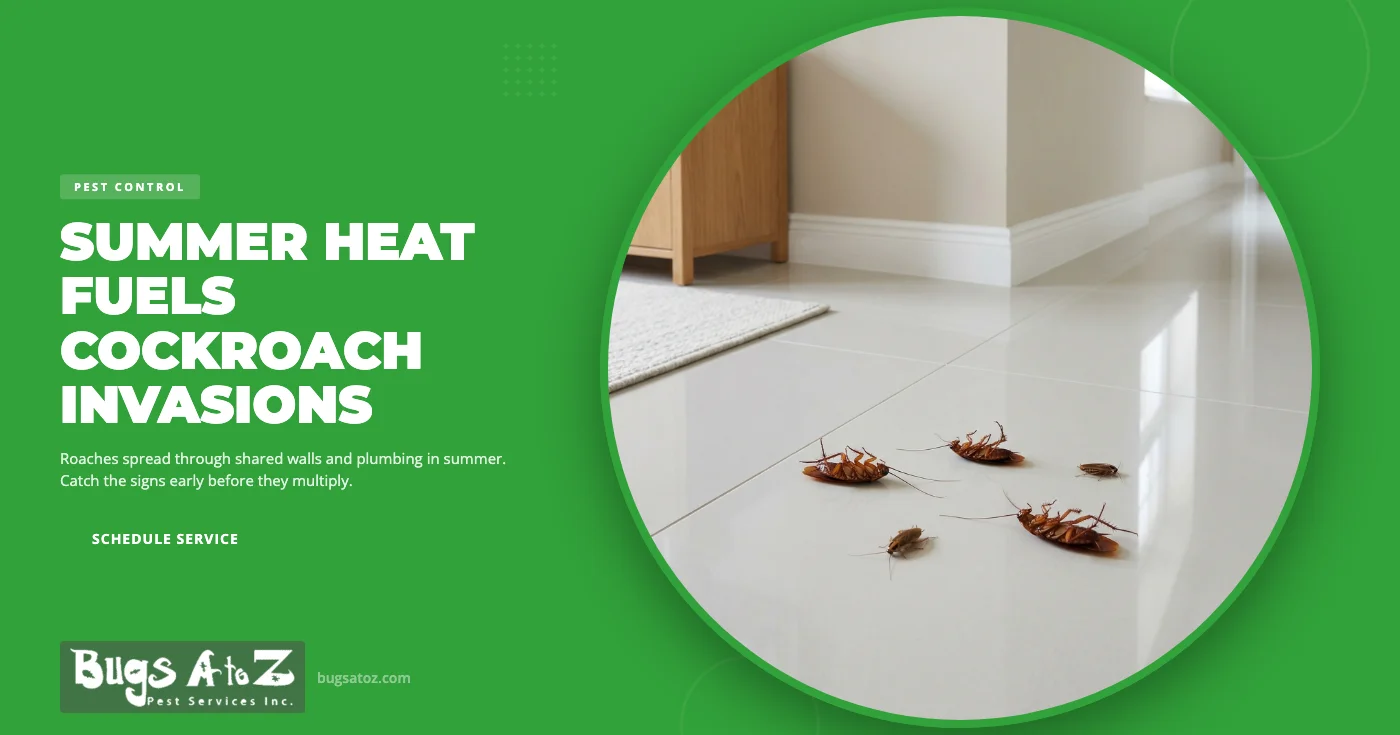
If you've ever turned on the kitchen light at midnight and found cockroaches scattering across the counter, you know the particular unease that comes with sharing your home with these insects. For Van Nuys, CA apartment residents, that experience becomes significantly more common during summer—and understanding why can help you take the steps needed to protect your unit before an isolated sighting becomes a full infestation.
Cockroaches are one of the most resilient pests on the planet. They've survived for more than 300 million years, outlasting mass extinction events, and they've had plenty of time to adapt to human environments. But their resilience doesn't mean they're undefeatable. It means you need to understand their behavior and use that knowledge strategically.
Why Van Nuys, CA Apartment Buildings See More Cockroaches in Summer
Van Nuys sits in the heart of the San Fernando Valley, where summer temperatures regularly exceed 95°F and humid microclimates develop in dense residential areas. That heat-humidity combination is close to ideal for cockroach reproduction—and in multi-unit apartment buildings, where dozens of separate living spaces share walls, plumbing stacks, and utility corridors, a cockroach problem in one unit rarely stays confined to just one unit.
Apartment buildings present cockroaches with an infrastructure network. Shared pipe chases let cockroaches move vertically through a building. Electrical conduits and wall voids serve as highways between units. HVAC systems can distribute populations across floors. This connectivity means that even the most careful tenant can end up with cockroaches originating from a neighboring unit, a laundry room, or the dumpster enclosure behind the building.
In summer, two things happen simultaneously that make this worse. First, cockroach reproduction accelerates dramatically. Most cockroach species produce more egg cases and hatch more young when ambient temperatures rise. Second, the outdoor populations that normally stay in warm, sheltered outdoor environments—storm drains, landscaping, trash areas—push closer to buildings as they seek water and food that becomes scarcer in the heat.
How Summer Heat Fuels Cockroach Breeding Cycles
Understanding cockroach reproduction helps explain why summer infestations can escalate so quickly. The German cockroach (Blattella germanica), which is the species most commonly found in Van Nuys apartment buildings, produces an egg case called an ootheca that contains up to 48 eggs. A single female can produce four to six egg cases in her lifetime, and at summer temperatures, the nymphs that hatch can reach reproductive maturity in as little as six weeks.
The arithmetic of this is daunting: a small group of German cockroaches introduced to an apartment building in spring can produce thousands of offspring by August. This is why early detection and rapid response are so critical. Waiting until you see cockroaches frequently—multiple sightings per day, activity during daylight hours—usually means the infestation has already grown well beyond what's visible.
The American cockroach (Periplaneta americana), larger and less common indoors than the German species, is also a summer problem in the Valley. These roaches typically live in sewers, storm drains, and outdoor plant beds but migrate into buildings through floor drains, sewer connections, and ground-floor gaps when outdoor temperatures peak. While they're less likely to reproduce inside a single apartment unit, they can enter in large numbers during heat waves.
The Most Common Cockroach Species in Van Nuys Apartments
Identifying which cockroach species you're dealing with matters, because different species have different habits, preferred habitats, and treatment approaches.
German cockroaches are the primary indoor species across Los Angeles and Ventura County. They're roughly half an inch to five-eighths of an inch long, tan to light brown, and identified by two parallel dark stripes running behind their heads. They prefer warm, humid environments—kitchens and bathrooms—and almost never venture outdoors voluntarily. If you're seeing cockroaches near your stove, under your refrigerator, or in bathroom vanity cabinets, German cockroaches are the most likely culprit.
American cockroaches are the large, reddish-brown roaches (up to two inches long) sometimes called "palmetto bugs." They come from outside or from the building's sewer infrastructure and are more common on lower floors. Seeing them in ground-floor apartments, particularly near floor drains, suggests a perimeter or infrastructure entry problem rather than a unit-level infestation.
Oriental cockroaches are dark, almost black, and prefer cool, damp environments like basement storage rooms, laundry rooms, and areas near water heaters. They're less common in the San Fernando Valley than the two species above, but they do appear in older apartment buildings.
Where Cockroaches Hide in Apartment Units
Cockroaches are cryptic—they spend the vast majority of their time in harborage sites that are dark, warm, and close to food or water. In a typical apartment, these locations include:
- Behind and beneath major appliances: The space behind your refrigerator and underneath your stove is an ideal cockroach habitat—warm from the motor, dark, and often littered with food particles. These are the first areas to check and the last areas most people clean thoroughly.
- Inside kitchen cabinets: The hinges and back corners of lower cabinets, particularly those under the sink, are common harborage points. German cockroaches especially favor the inside corners of cabinet interiors where they can stay in contact with two surfaces simultaneously.
- Pipe penetrations: Anywhere a pipe enters through a wall or floor—under sinks, behind toilet fixtures, at the water heater closet—is a potential entry and harborage point. Gaps around pipes are frequently unsecured in apartment units.
- Cardboard boxes: Cockroaches lay egg cases in corrugated cardboard, and moving boxes that sat in infested areas can introduce cockroaches to a previously clean unit. This is one of the most common ways infestations spread between buildings or move into newly occupied apartments.
- Electronics: Cockroaches are attracted to the warmth generated by electronics—computer towers, game consoles, cable boxes—and will nest inside them. This is one of the less intuitive harborage sites and a common vector for transporting cockroaches between units.
Signs You Have a Cockroach Problem
The earlier you identify cockroach activity, the more manageable the response. Key indicators include:
Droppings: German cockroach droppings look like black pepper or ground coffee—small, dark specks that accumulate in harborage areas and on surfaces near food preparation areas. A substantial accumulation of droppings indicates a well-established presence.
Egg cases: Empty or intact oothecae (egg cases) found in dark corners, behind appliances, or stuck to surfaces indicate active reproduction. German cockroach egg cases are small, light brown, and roughly a quarter inch long.
Odor: Large German cockroach infestations produce a distinctive, musty, oily smell that becomes more noticeable as populations grow. If a room has an unexplained unpleasant odor that doesn't respond to normal cleaning, cockroach activity is worth investigating.
Daytime sightings: Cockroaches are nocturnal. Seeing them during daylight hours is typically a sign that the population has grown large enough that nighttime harborage sites are overcrowded—a serious infestation indicator.
Smear marks: In high-humidity areas, cockroaches leave brownish smear marks along baseboards and walls where they travel regularly.
Cockroach Prevention for Van Nuys Renters
In a multi-unit building, individual tenants have limited control over what happens in shared spaces and neighboring units. But there are meaningful steps you can take within your own apartment to reduce attractants and make your unit less hospitable to cockroaches.
Eliminate food access: Cockroaches need food, water, and shelter. Denying them food is one of the most effective deterrents. Store pantry items in sealed containers—cockroaches can chew through thin plastic bags and cardboard boxes easily. Never leave dishes unwashed overnight. Clean up crumbs and spills immediately. Take out trash regularly, especially food waste.
Reduce moisture: German cockroaches are particularly sensitive to water availability. Fix leaking faucets and pipes. Dry out sink areas before bed. Run the exhaust fan during and after showers. Check under sinks for any water accumulation. A dehumidifier in problem areas can help reduce the ambient humidity that cockroaches need to thrive.
Seal entry points within your unit: Caulk gaps around pipes under sinks, around the base of toilet fixtures, and anywhere else you can see daylight or feel airflow. Steel wool packed into larger gaps before caulking prevents cockroaches from chewing through.
Inspect incoming items: Before bringing secondhand furniture, appliances, or boxes into your apartment, inspect them carefully. Pay special attention to the underside of furniture, the interior of cardboard boxes, and the backs of electronic devices.
Report promptly: If you're a renter, report cockroach sightings to your property manager immediately. In California, landlords have a legal obligation to maintain habitable conditions, which includes pest control. Early reporting also protects you by documenting that you reported the problem rather than allowing it to spread.
When Should I Call a Van Nuys Cockroach Control Expert?
Consumer-grade cockroach products—bait stations, sprays, and sticky traps—can suppress small, early infestations. But German cockroach infestations in apartment buildings are notoriously difficult to control without professional intervention because of the insects' ability to move between units, develop resistance to commonly used products, and reproduce faster than over-the-counter treatments can reduce populations.
If you're seeing cockroaches regularly, finding egg cases, or noticing activity during the day, it's time to contact a Van Nuys cockroach control professional. Professional treatment for German cockroaches typically involves a combination of targeted baiting in harborage areas, insect growth regulators that prevent nymphs from reaching reproductive maturity, and exclusion work to block entry points—an approach that addresses the infestation at multiple levels simultaneously.
In an apartment building context, coordinated treatment that covers multiple units is significantly more effective than treating individual units in isolation. A qualified pest control company can work with building management to develop a building-wide protocol that addresses the problem comprehensively rather than pushing cockroaches from one unit to another.
Summer in Van Nuys puts real pressure on apartment residents when it comes to cockroaches. But with vigilance, good sanitation habits, and professional help when it's needed, you can protect your home through the season. If you're seeing cockroach activity and want a professional assessment, contact our team for service in Van Nuys, the San Fernando Valley, and surrounding Los Angeles and Ventura County communities.