

Late Summer Yellow Jacket Aggression in Winnetka, CA: Why August Is Peak Wasp Season in the West Valley
Late Summer Yellow Jacket Aggression in Winnetka, CA: Why August Is Peak Wasp Season in the West Valley
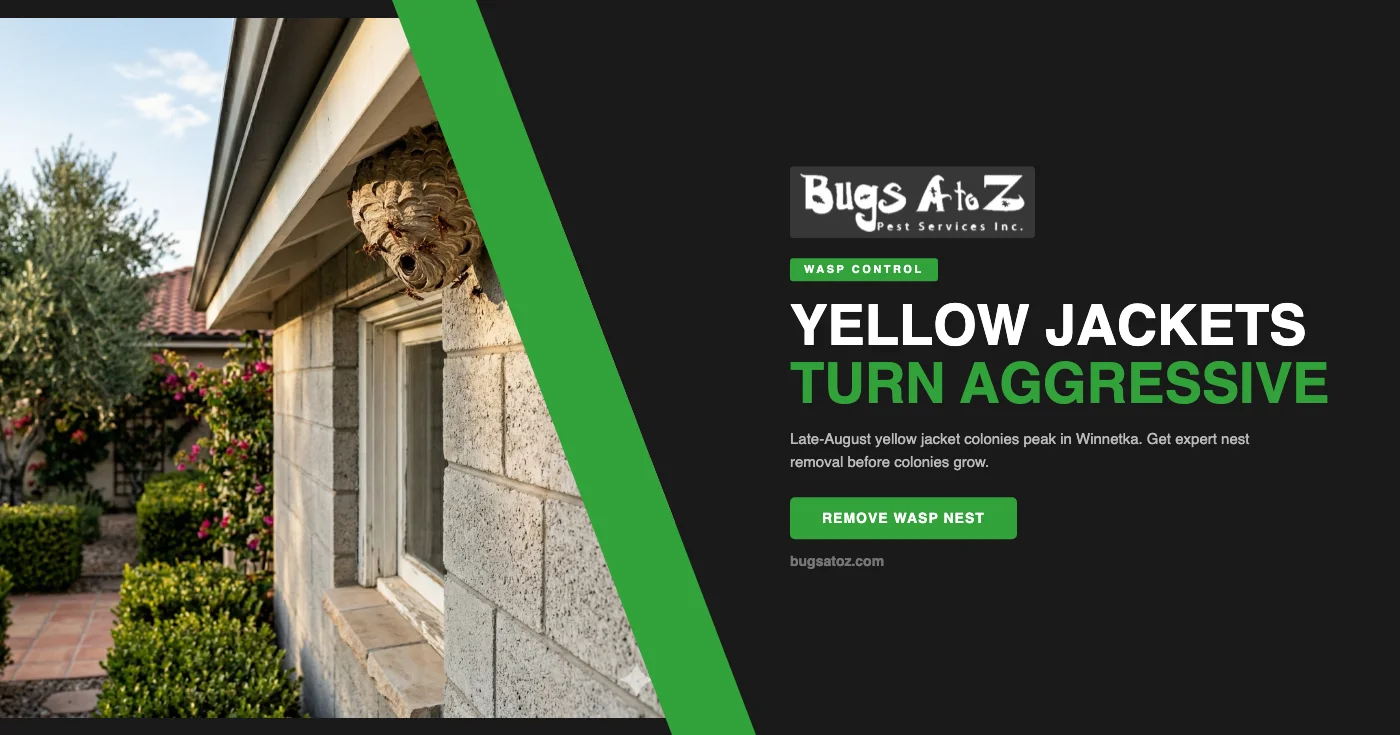
By late August, wasp activity in Winnetka hits its annual peak. Yellow jacket colonies that started as a single overwintered queen back in March have grown to full size — thousands of workers — and their behavior shifts from routine foraging to aggressive nest defense. Property owners across the West Valley notice it the same way every year: more wasps around outdoor eating areas, more encounters near irrigation heads and dropped fruit, and stings that seem to come out of nowhere while mowing the lawn or trimming a hedge.
At Bugs A to Z, we handle bee and wasp control as part of our full residential pest control lineup across Winnetka and the surrounding San Fernando Valley communities. Understanding why late-August wasps are so much more aggressive than the June version of the same species — and knowing where nests hide on West Valley properties — is the difference between a quick nest treatment and a family emergency room visit.
Why Yellow Jackets Are Most Aggressive in Late August in the San Fernando Valley
Yellow jacket colonies follow a predictable annual cycle. A single fertilized queen overwinters, emerges in spring, builds a starter nest, and lays the first batch of workers. Through summer, that initial handful of workers expands the nest, forages for protein to feed developing larvae, and grows the colony population. By August in the San Fernando Valley, a mature western yellowjacket colony contains anywhere from several hundred to a few thousand workers — the peak population for the entire season.
Peak population is only half the story. Late August also triggers a fundamental behavior shift inside the colony. New queens are being raised for next year, workers are producing fewer larvae, and the protein hunting that dominated early-summer foraging drops off. Instead, workers pivot to sugars — nectar, ripe fruit, sodas, spilled juice, and anything sweet within scent range. If you've noticed wasps circling your soda can on the patio in August that weren't there in June, this is why.
That sugar-scavenging behavior brings wasps into much closer contact with people. And it happens at the same moment when colonies are most defensive of their nests, because there's more to defend and more competition for shrinking food sources. Fallen fruit under backyard trees adds one more variable: as apples, plums, and figs ferment in the Valley heat, wasps feeding on them become intoxicated. Coordination drops and defensive stinging rises sharply.
The pattern is consistent enough that professional pest control operators across the West Valley plan their year around it. From late August through the first cool nights of October, Winnetka properties see peak wasp pressure. Colony decline follows after that, but the intervening six weeks are when most serious sting incidents occur.
Common Stinging Insects Found in Winnetka, CA This Time of Year
Not every stinging insect on a Winnetka property is a yellow jacket, and treatment strategy changes with the species. Here's what we most commonly identify on late-summer inspections across the West Valley.
Western yellowjacket (Vespula pensylvanica) — The dominant native yellow jacket across the San Fernando Valley. Half-inch to three-quarter-inch body, bright yellow and black bands, and almost always a ground-nesting species. Colonies live in abandoned rodent burrows, hollow tree bases, or cavities under decks and slabs. This is the species behind most late-summer sting emergencies in Winnetka.
German yellowjacket (Vespula germanica) — An invasive species now firmly established in urban Southern California. Similar in size and coloring to the western yellowjacket but noticeably more comfortable nesting inside structures — wall voids, attics, ceiling cavities, and behind exterior siding. German yellowjacket populations in Winnetka homes have been climbing over the past decade.
Paper wasps (Polistes species) — Longer bodied, slower flying, and much less aggressive than yellow jackets. Paper wasps build the exposed umbrella-shaped comb nests you see hanging from eaves, patio covers, and inside barbecue grills that haven't been used in a few weeks. They'll sting when the nest is directly threatened but rarely pursue.
Honey bees (Apis mellifera) — Not a wasp, but often mistaken for one. Honey bees are fuzzy and golden brown, not sleek and yellow-and-black. Bee colonies are protected under California law and should never be exterminated — swarms and hives require removal and relocation by a licensed beekeeper, which we coordinate as part of our bee removal service.
Correct species ID matters because a paper wasp nest and a ground yellowjacket colony call for very different treatment methods and personal protection.
Where Yellow Jackets and Wasps Build Nests on Winnetka Properties
Yellow jackets in Winnetka don't announce themselves. Ground-nesting colonies are usually invisible from the surface — a small entrance hole in a lawn edge, at the base of a shrub, or in a landscape crack — with the actual nest structure hidden a foot or more below the surface. Property owners often don't realize a nest is present until they mow over the entrance, run an irrigation line, or step on the wrong patch of ground.
Common ground-nest locations we find on West Valley properties:
- Abandoned rodent burrows — Ground squirrel, gopher, and vole holes are prime real estate for a foundress queen in spring. If you have rodent activity, you have future wasp nesting sites.
- Lawn edges and landscape transitions — Any spot where turf meets a hardscape, a planting bed, or a slope. These edges naturally develop small cavities from settling and irrigation.
- Under decks, patio slabs, and steps — The gap between a concrete pad and the surrounding soil is a classic nest cavity.
- Utility box openings and irrigation valve boxes — Voids underneath these are almost always accessible from below.
- Retaining wall drainage weeps — The gap behind block retaining walls creates an ideal, sheltered nest cavity.
Aerial nests are more visible but easier to miss than you'd think until they're large. Paper wasp nests hang from eaves, pergolas, patio umbrellas that haven't been opened in weeks, and inside grill covers. German yellowjacket nests inside wall voids show themselves only through the entrance hole — often a small crack in exterior stucco, a gap around a vent, or an opening at a utility penetration. If you see a steady stream of wasps entering and exiting a single point on the exterior of your Winnetka home, that's an active nest inside the wall.
How to Spot a Wasp Nest Before It Becomes Dangerous
The earlier you find a wasp nest, the less risky the treatment. A June nest with 40 workers is much easier to eliminate than the same nest in August with two thousand workers actively defending it. Regular property scanning during summer catches nests while they're still small.
What to watch for during a summer property walk:
- Repeated wasp traffic to one location — Stand still and watch. If wasps are consistently flying in and out of the same point on the ground, a wall, or an eave, that's an active nest entrance.
- Wasps disappearing into a hole in the lawn or landscaping — Any hole a wasp enters is worth marking and monitoring. If activity continues over multiple days, treat it as a confirmed nest.
- Visible paper comb under eaves — Paper wasps build early nests as small as a quarter. These are easy to spot from May through July if you look for them.
- Increased wasp activity near a specific outdoor area — If wasps consistently show up around one part of the yard, patio, or side of the house, there's a nest nearby drawing them.
- Sudden burst of activity after a disturbance — If mowing, weeding, or watering a specific spot triggers a swarm of wasps, back away immediately. That's a defensive response to nest disturbance.
Time of day matters. Wasps are most active during warm daylight hours and return to the nest by dusk. Do your property scan late morning or early afternoon when workers are actively foraging in and out — that's when nest entrances are easiest to identify.
Once a nest is confirmed, mark the location clearly, keep family members and pets away from that area, and arrange treatment. The nest won't disappear on its own until frost — and Winnetka rarely gets frost.
Why DIY Wasp Removal Is Risky in the West Valley
Every August, emergency rooms across the San Fernando Valley treat sting cases from homeowners who tried to eliminate a wasp nest themselves. The store-bought foam sprays and homemade methods circulating online underestimate what a mature colony can do when disturbed, and the risk is significantly higher than most people expect.
Alarm pheromone response. When a yellow jacket stings, it releases a chemical alarm signal that summons every worker within range. A single defensive sting can escalate to dozens of stings in under a minute. Unlike honey bees, yellow jackets don't lose their stinger after one strike — they can sting repeatedly, and the same worker will pursue a target hundreds of feet from the nest.
Multiple stings and systemic reactions. For someone without a venom allergy, multiple wasp stings can still trigger a systemic toxic response — swelling, nausea, dizziness, muscle weakness — that requires medical attention. The threshold varies by body weight, age, and health status, but a couple dozen simultaneous stings is enough to send an average adult to the hospital.
Anaphylaxis risk. Roughly three percent of the population has a venom allergy that can trigger anaphylactic shock from a single sting — a life-threatening reaction that requires epinephrine within minutes. Many people don't know they're allergic until their first serious sting incident.
Ground-nest specifics. Underground colonies are the worst DIY target. Store-bought sprays penetrate only a few inches into the entrance tunnel and rarely reach the actual nest chamber below. What they reliably do is anger the colony. West Valley pest control operators regularly get called out to properties where a homeowner sprayed a ground nest the night before and now can't step within twenty feet of that section of the yard.
Wall-void nests. Spraying a wall entrance drives workers deeper into the structure — often into interior wall cavities where they eventually find their way into the living space through outlets, light fixtures, or attic access hatches. These situations require professional removal and structural inspection to resolve.
Professional Wasp and Bee Removal Services in Winnetka, CA
Our wasp control in Winnetka is designed around the West Valley's specific conditions — the mix of native western yellowjackets, established German yellowjacket populations, and paper wasp species found across San Fernando Valley properties. Each service starts with correct species identification, because a paper wasp treatment on a ground yellowjacket colony is a recipe for a bad outcome.
For active nests, we apply targeted professional-grade treatment directly to the nest structure — dust formulations for ground colonies and wall voids that penetrate to the nest chamber, and residual liquid or foam treatments for aerial nests. Full protective equipment during the treatment is standard on every job, and we sequence the work for late evening or early morning when workers are inside the nest rather than dispersed foraging. Follow-up inspection confirms the colony has been eliminated.
For repeat-nesting properties, we build a recurring service around the property's specific problem areas — a rodent burrow that keeps getting colonized in spring, an accessible eave line that draws paper wasps, or a wall void that has developed a pattern of German yellowjacket nesting. Preventive treatments applied at the right points in the season substantially reduce late-summer colony pressure the following year.
Honey bee swarms and established hives are a separate service — we coordinate live removal and relocation with licensed beekeepers rather than exterminating protected pollinators. Never spray a honey bee swarm or hive; call us first for identification and proper removal.
To schedule wasp and bee control for your Winnetka property, contact Bugs A to Z. We serve homes throughout the West Valley — Winnetka, Woodland Hills, Canoga Park, West Hills, Chatsworth, Reseda, and surrounding San Fernando Valley communities — with treatment programs designed around the region's stinging insect species and their late-summer aggression patterns.