

Yellow Jacket & Wasp Control in Winnetka, CA: Why September Is Peak Season and How to Protect Your Home
Yellow Jacket & Wasp Control in Winnetka, CA: Why September Is Peak Season and How to Protect Your Home
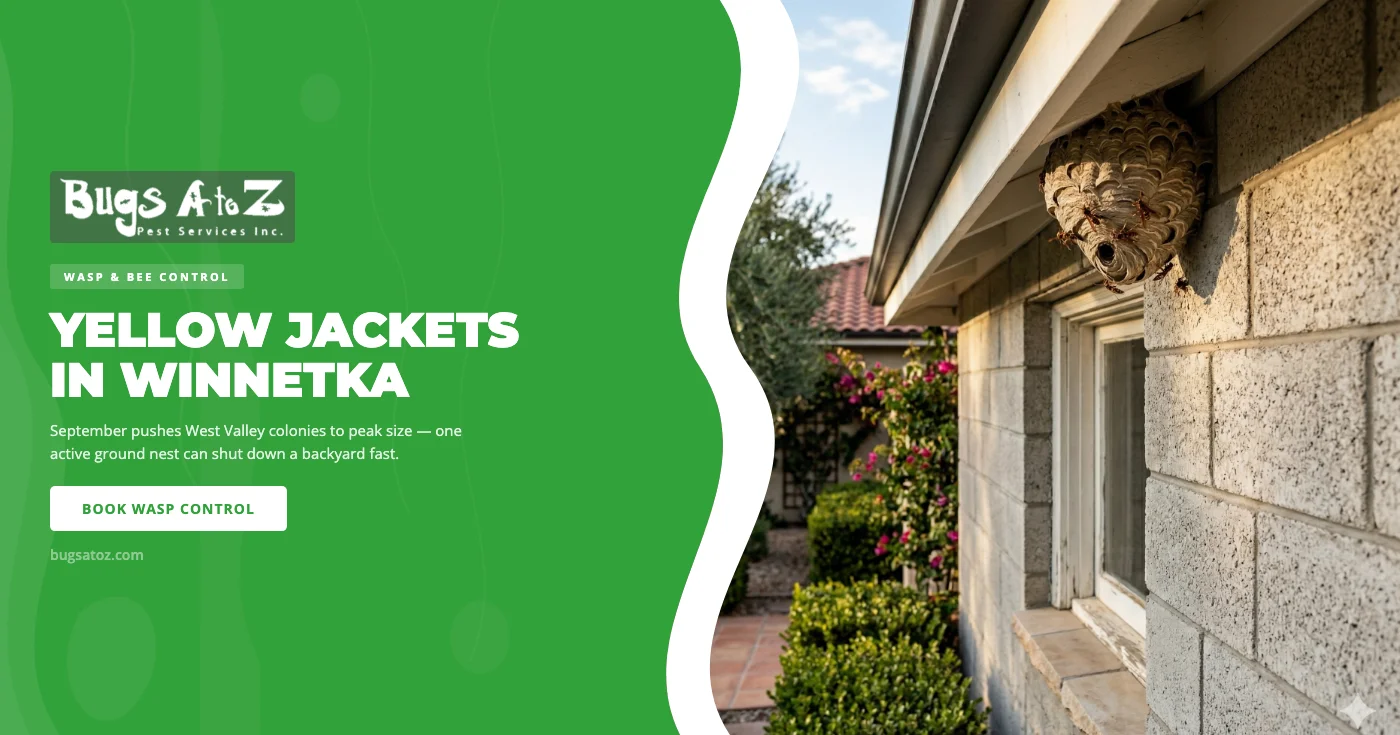
September in Winnetka is when yellow jacket and wasp pressure across the West Valley hits its annual maximum. Colonies that started as a single overwintered queen in March have grown to peak size — up to several thousand workers in a single ground nest — and their behavior has shifted from routine foraging into aggressive nest defense and sugar scavenging. Homeowners across the San Fernando Valley notice it every fall: more wasps around trash bins and outdoor eating areas, more traffic near irrigation heads and fallen fruit, and defensive swarms that come out of nowhere when someone mows over the wrong patch of lawn.
At Bugs A to Z, we handle bee and wasp control as part of our full residential pest control lineup across Winnetka and the surrounding West Valley. Knowing why September wasps are the most dangerous version of the same species you saw in June — and knowing where their nests hide on West Valley properties — is what turns a routine service call into a prevented emergency room visit.
Why Winnetka Yards Are Prime Yellow Jacket Territory in September
Yellow jacket colonies follow a predictable annual cycle. A fertilized queen overwinters, emerges in spring, builds a starter nest, and lays the first workers. Through summer those workers expand the nest, hunt protein for developing larvae, and grow the population. By September in the San Fernando Valley, a mature western yellowjacket colony holds anywhere from 1,500 to several thousand workers — the peak of the annual cycle, per UC Integrated Pest Management research.
Peak population is only half of what makes September so difficult. The other half is a behavior shift inside the colony. New queens are being raised for next year, worker production of larvae drops off, and the protein-hunting that dominated early-summer foraging pivots hard toward sugars — nectar, ripe fruit, sodas, spilled juice, and anything sweet within scent range. If you're seeing wasps circling your drink in September that weren't there in June, this is why.
Winnetka yards feed the pattern in a few specific ways. Backyard fruit trees drop apples, plums, and figs that ferment in the September heat, drawing sugar-hungry wasps in from a wide radius. Ground-squirrel and gopher burrows scattered through lawns and beds give overwintering queens the exact cavity they need to start colonies the following spring. And the West Valley's dry conditions push wasps toward irrigation heads and drip lines. All three factors combine in September to concentrate wasp activity around the places people actually use — patios, pool decks, side yards, and back gardens.
How to Spot an Active Yellow Jacket or Wasp Nest Near Your Home
Yellow jackets in Winnetka rarely announce themselves. Ground-nesting colonies are usually invisible from the surface — a small entrance hole at a lawn edge, at the base of a shrub, or in a landscape crack — with the actual nest structure hidden a foot or more below. Property owners often don't realize a nest is present until they mow directly over the entrance, run an irrigation line through it, or step on the wrong patch of ground.
What to watch for during a September property walk:
- Repeated wasp traffic to one location. Stand still for two minutes and watch. If wasps are consistently flying in and out of the same point on the ground, in a wall, or under an eave, that's an active nest entrance.
- A wasp disappearing into a hole in the lawn or landscape. Any hole a wasp enters is worth marking and monitoring. If the traffic continues for multiple days, treat it as a confirmed nest.
- Visible paper comb under eaves and patio covers. Paper wasps build exposed umbrella-shaped nests as small as a quarter early in the season. By September these can span several inches.
- A defensive swarm triggered by mowing or trimming. If routine yard work in a specific area suddenly produces angry wasps, back away immediately. That's a defensive response to nest disturbance.
- A steady stream of wasps at a single point on the exterior of your home. A crack in stucco, a gap around an attic vent, or a utility penetration with constant wasp traffic is almost always a German yellowjacket nest inside the wall.
Timing matters. Wasps are most active during warm daylight hours and return to the nest by dusk. Do your property scan in mid-morning or early afternoon when workers are actively foraging in and out — that's when nest entrances are easiest to identify. Once a nest is confirmed, mark the location clearly, keep pets and children well away from that area, and arrange treatment. The nest will not disappear on its own until true frost, and Winnetka almost never gets frost.
The Risks of DIY Wasp Nest Removal in Late Summer
Every September, emergency rooms across the San Fernando Valley treat sting incidents from homeowners who tried to eliminate a wasp nest themselves. The store-bought foam sprays and the "just pour gas down the hole" methods circulating online underestimate what a mature colony can do when disturbed, and the risk is significantly higher than most people expect.
Alarm pheromone response. When a yellow jacket stings, it releases a chemical alarm signal that summons every worker within range. A single defensive sting can escalate to dozens of stings inside a minute. Unlike honey bees, yellow jackets do not lose their stinger after one strike — they sting repeatedly, and the same worker will pursue a target hundreds of feet from the nest.
Multi-sting toxic reactions. Even for someone without a venom allergy, multiple wasp stings can trigger a systemic toxic response — swelling, nausea, dizziness, muscle weakness — that requires medical attention. The threshold varies by body weight, age, and overall health, but a couple dozen simultaneous stings is enough to send an average adult to the hospital.
Anaphylaxis risk. Roughly three percent of the population has a venom allergy severe enough to trigger anaphylactic shock from a single sting. Many people don't know they're allergic until their first serious sting incident, and anaphylaxis requires epinephrine within minutes.
Ground-nest specifics. Underground colonies are the worst DIY target. Store-bought aerosol sprays penetrate only a few inches into the entrance tunnel and rarely reach the actual nest chamber a foot or more below. What they reliably do is anger the colony. West Valley pest control operators regularly get called to properties where a homeowner sprayed a ground nest the night before and now can't step within twenty feet of that section of the yard.
Wall-void nests. Spraying a wall entrance drives workers deeper into the structure — often into interior cavities where they find their way into living space through outlets, light fixtures, and attic hatches. These situations require professional removal plus a structural inspection, and the initial DIY spray usually makes both harder.
What Professional Wasp and Bee Control Looks Like
Our wasp control in Winnetka is built around the West Valley's specific mix of stinging insects — the dominant native western yellowjacket, established populations of the invasive German yellowjacket in urban structures, and paper wasps that colonize eaves and patio covers each summer. Every service starts with correct species identification, because a paper wasp treatment applied to a ground yellowjacket colony is a recipe for a very bad afternoon.
For active nests, we apply targeted professional-grade treatment matched to the location and species. Dust formulations penetrate ground colonies and wall voids to reach the nest chamber below the entrance. Residual liquid and foam treatments handle aerial paper wasp and German yellowjacket nests under eaves. Full protective equipment is standard, and we sequence the work for early morning or late evening when workers are inside the nest. A follow-up inspection a few days later confirms the colony is eliminated and there is no remaining traffic.
For properties with recurring wasp problems, we build a preventive service around the specific patterns — a rodent burrow that keeps getting colonized in spring, an eave line that draws paper wasps year after year, or a wall void with a history of German yellowjacket nesting. Treatments applied at the right points in the season substantially reduce late-summer pressure the following year.
Honey bee swarms and established hives are handled separately. Honey bees are protected under California law and should never be exterminated. When we identify a honey bee swarm or established hive on a Winnetka property, we coordinate live removal and relocation with a licensed beekeeper as part of our bee removal service. Never spray a honey bee swarm — call for identification first.
How to Wasp-Proof Your Winnetka Outdoor Living Spaces
Even without an active nest on the property, September wasp pressure across the West Valley is high enough that most Winnetka yards benefit from a few simple prevention steps. Reducing what draws foraging workers to your patio and pool area cuts both the number of encounters and the odds of a serious sting.
- Pick up fallen fruit daily. Apples, plums, figs, and citrus dropping from backyard trees ferment quickly in the September heat and become powerful wasp attractants. A five-minute yard walk each morning removes the strongest lure on the property.
- Keep trash and recycling bins tightly closed. Sugar residue from soda cans and food packaging is a major September draw. Rinse recycling containers, keep lids sealed, and store bins away from patios and doorways where possible.
- Cover food and drinks at outdoor gatherings. Open cups and open plates are the number-one cause of accidental sting incidents in late summer. Use lids on drinks and keep food covered until it's ready to eat.
- Fill in old rodent burrows. A ground squirrel or gopher hole is next spring's yellow jacket nest site. If you see rodent activity in the yard, addressing it now removes future nesting cavities.
- Repair gaps in exterior stucco, vents, and utility penetrations. Any pencil-diameter gap on the exterior of the house is a potential German yellowjacket entry point. Sealing them in fall closes the door before next year's queens go looking.
- Trim vegetation away from eaves and patio covers. Sheltered corners with overgrown planting nearby are prime paper wasp sites. Trimming back creates less-attractive nesting real estate.
These steps don't eliminate wasp activity, but they reliably reduce the pressure enough that outdoor spaces stay usable through the September and early October peak.
When to Call an Emergency Bee and Wasp Control Expert
Some wasp situations can wait a day or two. Others need same-day professional response. Knowing the difference protects your family and prevents small problems from becoming trips to the emergency room.
Call for professional wasp and bee control right away if any of the following apply on your Winnetka property:
- An active nest is near a door, walkway, driveway, or high-traffic outdoor area. Proximity to daily foot traffic dramatically raises the odds of a defensive sting event.
- Wasps are actively entering a wall void, attic, or interior ceiling cavity. Structural nests can push workers into living spaces and need immediate professional handling.
- Someone in the household has a known venom allergy. Even a distant nest presents unacceptable risk when anaphylaxis is on the table.
- A ground nest has already been disturbed. Once a colony has been agitated — by mowing, spraying, or an accidental step — the property is not usable near the nest until it's professionally treated.
- You've identified a honey bee swarm or established hive. These require licensed beekeeper coordination, not extermination. Call for identification before anyone attempts to handle it.
To schedule wasp and bee control for your Winnetka property, contact Bugs A to Z. We serve homes throughout the West Valley — Winnetka, Woodland Hills, Canoga Park, West Hills, Chatsworth, Reseda, Northridge, and surrounding San Fernando Valley communities — with treatment programs built around the region's stinging insect species and their September peak behavior.